
Downey High’s class of 1966 looks back
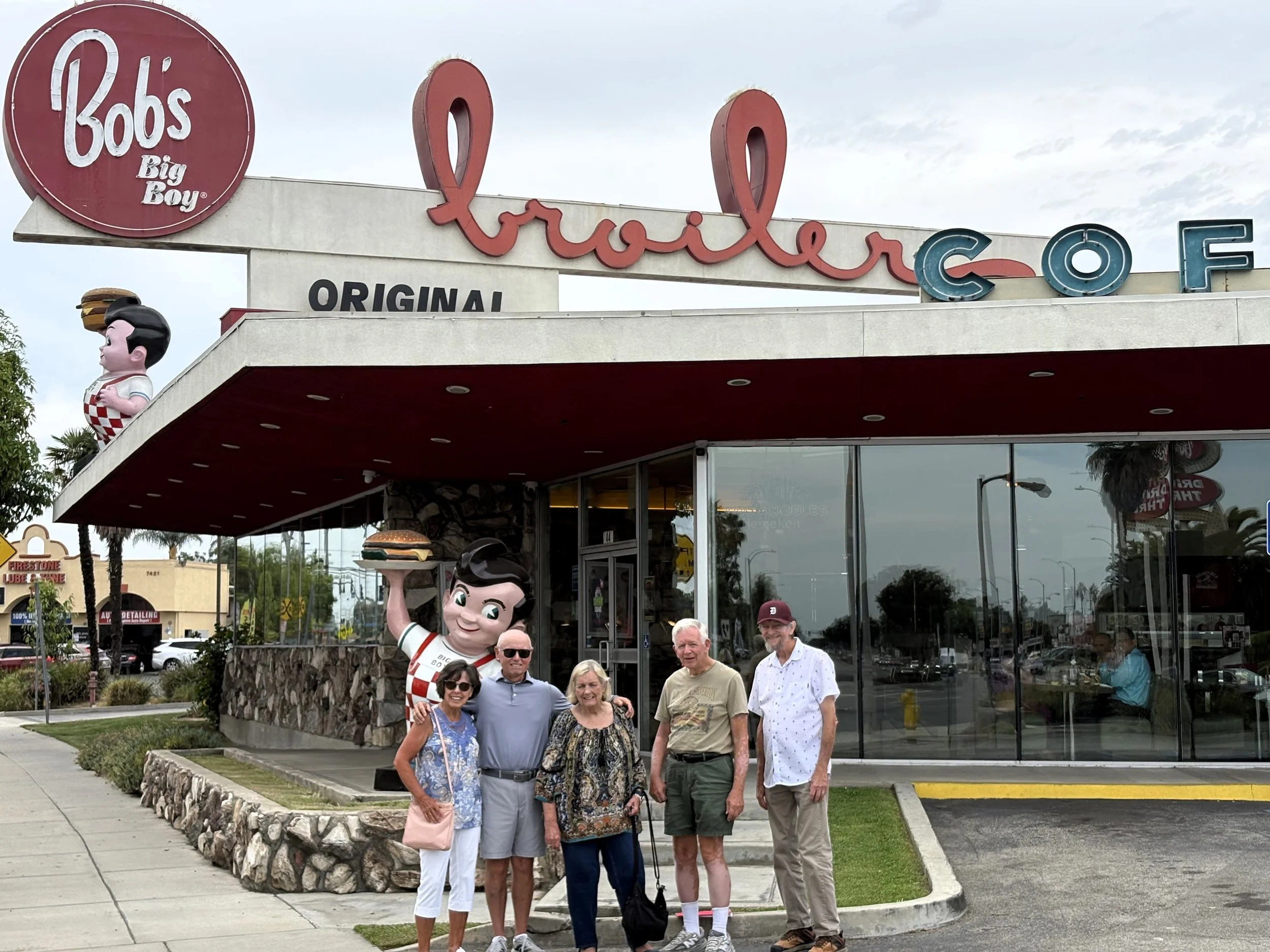
Downey High School Class of 1966 alumni returned to Bob’s Big Boy in Downey as they prepared to celebrate their 60th reunion. Pictured from left are Carlene Case Anderson, Lou Miramontes, Marlene Eich, John Furbish and Dan Armstrong.
DOWNEY — Lyndon Johnson was president of the United States. The American presence in Vietnam was escalating and would ultimately claim the lives of two of our classmates, Randy Liggett and Johnnie Edwards. The median cost of a home was just over $23,000, affordable to families whose average income was $7,400. Of course, if you hoped to live on Gainford in North Downey, a $40,000 price tag was more like it.
The seeds of several social movements had already been sown. Nightly, Walter Cronkite told us about anti-war protesters and the civil rights movement. The National Organization for Women was founded in 1966. Some of the images were hard to watch, but not all television was anger and bitterness. In the years that followed, the Smothers Brothers made us smile until they got fired by CBS. We were introduced to one of the most enduring franchises in TV and motion picture history when Star Trek debuted in 1966 on NBC. Of course, it wasn’t just science fiction in Downey, where the folks at North American Aviation were creating command modules for the Apollo program, which made the moon landing possible.
World-shaking events seemed common during the 1965-66 school year for the more than 750 seniors at Downey High. Memories of those events will likely take a back seat to personal conversations, however, when former members of the class of 1966 gather for their 60th high school reunion on Saturday, Sept. 26, on the Downey High campus.
“We are incredibly excited for our reunion and looking forward to this special event,” said Carlene Case Anderson, who chairs the committee that has been planning the reunion for the past year. “Some places never leave us. They live in our memories, our friendships and our hearts.”
Tickets to the reunion are available at $75 per person. Checks may be sent to Marlene Eich, FOB DHS66, 12435 Tudor Way, Tustin, 92780. Those who would like to add a little golf the day before the reunion may contact John Furbish at 714-401-1990 or furbodude@aol.com.
Festivities will begin at 3 p.m. with a welcome, check-in and appetizers. Dinner, dessert and coffee will be served between 4:30 and 6:30 p.m. Tributes are planned for the more than 100 classmates who have passed away and to members of the class who are veterans.
Dress is summer casual. Shorts, capris and flip-flops are welcome. Inquiries about the reunion may be directed to Carlene Anderson at 714-847-2043, carlene48@verizon.net.
Framed brief historical vignettes will adorn tables at the reunion. They describe the places the class of 1966 went to hang out, show off their cars, eat burgers, pizza and Mexican food, and “cruise” Stonewood. At the Downey Patriot’s invitation, members of the class shared the following memories of what life was like for Downey teenagers 60 years ago.
Cruising Stonewood
The opening of Stonewood Center wasn’t good news for merchants in Downey’s downtown area, but it was pretty much all positives for teenagers. In addition to the obvious convenience of being able to buy almost anything you needed at one location, there were opportunities for first jobs, necessities like candy, ice cream or an Orange Julius, and a place to hang out—to see and be seen.
Stonewood opened in 1958, just a couple of blocks from the high school at Lakewood and Firestone, one of the busiest intersections in the country before freeways crisscrossed the area. The name Stonewood came from combining the second syllables of Firestone and Lakewood. It was the eighth mall in the greater Los Angeles area. At first, it was rather modest compared to today’s malls, but things began to change in our senior year, when a new anchor store, The Broadway, opened. About the same time, we all had the chance to make ourselves pigs with the addition of a Farrell’s Ice Cream Restaurant.
The first stores and services at Stonewood included W.T. Grant, J.C. Penney, F.W. Woolworth, a Shopping Bag market, Rexall Drug, Helen Grace Candies, Western Auto, Oval Room Fashions, Toyville, Orange Julius, Woody’s Men’s Store, Anita Shops, Stonewood Music Center, the Magic Mirror Beauty Salon and Zella Brumley’s Sports Togs. In our sophomore year, a single-screen Showcase Cinema opened. Later, a second screen was added.
After our graduation, Stonewood continued to grow, adding Mervyn’s, Robinson’s-May and 40 to 50 other shops and stores. Big changes were still in store, however, as new owners completely enclosed the mall, and trendier stores replaced most of the ones we frequented.
Big things are still going on at Stonewood. A multiphase modernization project will be highlighted by a three-story bowling and arcade facility, which will also include karaoke, billiards and a Spo-Cha sports zone. Sounds like it would have been a lot of fun in our day.
At the movies
Those of us who enjoyed a Downey childhood probably remember trips to the Avenue and Meralta theaters, where for about 35 cents, you got to see a cartoon or two, two movies and maybe the latest installment of a hair-raising western serial. Not to worry if you came in a little late. You just stayed in your seat until the first movie came back around to see what you missed. “This is where we came in” was almost universally heard.
The Avenue and Meralta were just a block apart on Downey Avenue. They weren’t your only options for a movie outing. The same company owned the Norwalk Theater on Firestone, and there was always the Nubel on Bellflower Boulevard.
About the time we started Downey High, both the Avenue and Meralta got a nice face-lift, including the Avenue’s marquee, which can still be seen today. It welcomes you to Avenue Pizzeria, a great spot for night owls, since it’s open until 3 a.m. on Friday and Saturday nights. The Meralta wasn’t so lucky. It was torn down in 1978 and replaced by a parking lot.
Both theaters showed first-run movies after their remodeling projects, and more than a few of us had first dates there. Among the top motion pictures around the time of our senior year were “The Sound of Music,” “My Fair Lady,” “Doctor Zhivago,” “Grand Prix” and “The Good, the Bad and the Ugly.” You could no longer get in for 35 cents, but the average cost for a movie in 1965-66 was only a little over a dollar.
Both theaters opened in the 1920s, the Avenue first, followed by the Meralta two years later. The Meralta was originally run by Pearl Merrill and Laura Peralta, who each donated a syllable or two to create the name. Shortly after we graduated, the theaters began a decline that eventually led to their closing. Multiplex theaters became more popular than those with single screens.
Also, downtown areas lost a lot of business to malls. Between the two cultural changes, the Avenue and Meralta were doomed.
Seeing and being seen at McDonald’s
In 1966, you could buy one of the “500 million served” hamburgers at what is now the longest-operating McDonald’s for 19 cents. You could save a little by going to “Little Macs” on Paramount Boulevard, where the burgers were only 15 cents, but then you’d miss the spectacle that unfolded nightly at Lakewood and Florence.
Kids. Lots of them. Hanging out. Making out in back seats. Catching up on the day’s gossip. Getting rubber in the parking lot turned drag strip paralleling Lakewood Boulevard. Although we ate, too, it wasn’t hunger that attracted us; it was the opportunity to see and be seen. We drove the management crazy, and at times they resorted to security guards to try to ensure that everybody bought something and then returned to their car. It was mostly a losing battle.
“Our” McDonald’s was always a little different. That’s because it was franchised from the original McDonald brothers before Ray Kroc bought the chain. An independent franchise, the Downey McDonald’s didn’t always follow the corporate rules. Our menu was always a little different. Eventually, that caught up with the restaurant when the country went crazy over Big Macs, and the Downey McDonald’s didn’t sell them.
That wasn’t the only thing that contributed to the decline of the restaurant. It was acquired by the corporation, which was dismayed when it was determined there wasn’t room for a drive-through. Then, in 1994, McDonald’s was damaged in the Northridge earthquake. Corporate decided to close its oldest operating location. That’s when Downey civic leaders, many of whom had once hung around with their friends in the McDonald’s parking lot, stepped in and urged that the restaurant be preserved. Corporate relented, kept the oldest McDonald’s open, and even added a small museum and gift shop. In 2016, the long-awaited drive-through was added. In the past two years, an ambitious refurbishing project has restored the iconic McDonald’s sign, complete with the original mascot, SpeeDee, who was born in 1948, just like most of us.
Cars and cruising at Harvey’s
If going to McDonald’s was about seeing the people, going to Harvey’s Broiler was definitely about looking at the cars. And that’s just how founder Harvey Ortner envisioned it when he and his wife, Minnie, opened the Broiler in 1958. Prior to the Ortners, the property at Firestone Boulevard and Old River School Road was a poultry ranch. Harvey Ortner recognized it as an ideal location for a restaurant.
Noting visibility of up to a mile from either direction on Firestone, Ortner pictured the Broiler in the “Googie” style of architecture, topped by the famous Broiler sign in red script, a sure attraction to the booming car culture of the late ’50s and ’60s. Ortner, who previously was an owner of the Clock Drive-In in Bellflower, already knew a lot about attracting “kustoms,” cruisers and hot rods.
Harvey’s Broiler was open 24 hours a day. You could eat inside or be served by carhops outside until 4 a.m. Long lines of cars trying to get into the Harvey’s parking lot caused the city of Downey to ask if the carhop service could be trimmed to 2 a.m. Harvey’s complied. It wasn’t especially a Downey crowd in those long lines. Car club members made circuits starting in Long Beach, Hawthorne and Los Angeles. Saving the best for last, the circuits ended at Harvey’s.
Ill health caused the Ortners to look into selling their famous Broiler in 1968. An apparent deal with an investor named Johnson caused Harvey’s to be renamed Johnie’s Broiler. The deal fell through; the new sign stayed. Whether called Harvey’s or Johnie’s, the classic look of the Broiler has made it the subject of numerous movies, television shows, music videos, advertisements and magazine covers.
On New Year’s Eve 2001, Johnie’s Broiler was closed as a restaurant. It became a used car dealership, and in 2007, a new tenant, undeterred by the city’s refusal to issue a demolition permit for the historic building, began knocking it down. Horrified Broiler fans called the police, but much damage was done. The famous sign survived. A year later, Bob’s Big Boy stepped in. Harvey’s is now the Bob’s Big Boy Broiler, still welcoming custom and classic cars.
Pizza and friendly rivalries
Bears bad. Pizza good. — Anonymous
There weren’t as many places to get pizza in the 1960s as there are now, but Downey had some really good ones. If you wanted your pizza with a large side of other teenagers, you probably headed for Shakey’s on Paramount Boulevard. Shakey’s made it easy to be around other teens with two seating sections. The one on the left was for kids and served sodas. The one on the right, open to adults and families, served beer and wine. Of course, Paramount Boulevard is in Warren territory, so there would likely be some blue and gold letterman’s jackets among the maroon and white.
When you entered Shakey’s, you placed your order at the counter, where you received a red square with a large block number on it. You returned, number in hand, to retrieve your pizza a few minutes later, probably from a young person in a striped shirt and a straw streamer hat. There were several places in town where the pizza was probably better, but none surpassed Shakey’s for economy and hanging out. In the 1960s, you could get a small Shakey’s pizza for as little as $1.20. A giant Big Ed’s special, a combination with all the toppings, was $3.65, a price easily shared among three or four hungry teens.
For dates or family dinners, you might be interested in more decorum than that found at Shakey’s. Frantone’s on Telegraph Road was an option. The pizza was only pennies more than at Shakey’s, and the menu, displayed on the wall, was far more complete. It included salads, sandwiches and the usual pasta dishes—spaghetti, ravioli and lasagna—all strictly made from the recipes of co-owner Rose Tesoriero. Full orders of spaghetti and ravioli were only $1.50. Sadly, the original Frantone’s closed two years ago, but if you’re willing to drive a little, you’ll find the new Frantone’s on Alondra Boulevard, a few blocks from Cerritos College.
Among the good take-out pizza choices were Carlo’s and Pina Family Pizza. If you’re in Downey for an extra day or so around the reunion, Shakey’s, Frantone’s, Carlo’s and Pina, all well over half a century old, are still serving up yummy pizza.
The original Taco Bell
OK, you would never confuse the tacos with Esther’s or the burritos with nearby Guadalajara, but you have to admit Glen Bell had a pretty good idea when he opened the first Taco Bell up Firestone Boulevard from Downey High, just before we started classes there. You might call it a $130 million idea, since that was the price tag when he ultimately sold the popular Mexican food chain to Pepsi in 1978.
Taco Bell might not have earned high marks for authenticity or ambiance, but you couldn’t argue with the convenience or the prices. As was the case with most fast-food restaurants of that era, the menu was very simple. Customers had their choice of tacos, red or green burritos, “tostados,” frijoles and chili burgers. Every item was 19 cents. You could wash it all down with Coke, orange soda, root beer or coffee, 10 cents for a small, 20 cents for a large. Little on the menu had changed by the time we graduated. Royal Crown cola had replaced Coke, and the Bell Burger had taken the place of the original chili burger. The price of the food items had “exploded” to 25 cents each.
The first Taco Bell was a modest building, just 20 by 20 feet. Its roof was clay tile, and there were arched entryways. There was no indoor seating. It was well-received, however, and owner Bell soon had eight new locations. By 1967, there were 100 Taco Bell restaurants throughout the greater Los Angeles area.
All that success eventually proved fatal for the original Taco Bell. In the 1980s, PepsiCo mounted a campaign to make Taco Bell restaurants more upscale. The first location couldn’t pass muster and was closed. Over the next several years, the building was home to several other small fast-food restaurants, finally closing its doors in 2014. To its credit, rather than demolish the building, the property management company reached out to Downey Conservancy, a group dedicated to preserving the city’s heritage. Taco Bell and Downey Conservancy arranged to move the original 400-square-foot building to the company’s headquarters in Irvine. A quixotic five-hour caravan saw the old restaurant move from Downey to Irvine, arriving just before 2 a.m. on Nov. 20, 2015.
A taste of Esther’s
Taco Bell was first opened in Downey in 1962 by Glen Bell, who invented (some say stole) the idea of the fast-food taco in a reheated shell. One of Bell’s associates founded Del Taco. Four years before Bell started Taco Bell, he co-founded another Mexican fast-food place, El Taco, which is still serving up tacos and burritos on Florence Avenue. You can make a strong case that Downey is the birthplace of Mexican fast food as we know it. Sometimes, however, fast Mexican just doesn’t get it done.
Guadalajara Plaza on Firestone was a neighbor of the original Taco Bell, which is now being housed in a parking lot behind the company’s corporate headquarters in Irvine. Guadalajara certainly wasn’t elegant, with wooden tables, benches, and a huge menu painted on the wall. The food was good, however, especially the burritos. Especially the green burritos. Old Guadalajara patrons still post online how much they miss those burritos. Guadalajara closed about 2000.
Tucked away near the old K-K Market on Woodruff Avenue was Esther’s Taco House. Esther opened the little takeout restaurant with her mother in 1957. Eventually, each of her four daughters helped Esther with her eatery. The youngest of the four is Linda Senteno (Claprood), a member of our class.
The official name was Taco House, but we all referred to it as Esther’s, so finally, she did too. Originally, the restaurant was nearly all kitchen, with a small area to order and wait. There was only room for one small table for waiting customers. A shoe repair place next door went out of business and gave Esther the opportunity to add a dining room.
In the 1970s, Linda returned to help her mother with the restaurant, and eventually, Linda’s sons Brian and Russell worked there, too. Esther passed away in 1994, and Linda moved the family restaurant to Orange County. You’ll find it today, still serving yummy Mexican food, in Placentia.
A night at Wonderbowl
Bowling alleys aren’t for everyone, but you couldn’t fault Downey’s Wonderbowl for trying to be. The Wonderbowl had bowling, of course, lots of it. But there were also pool, darts, pinball machines, a coffee shop and a room called the Gold Crown Room for parties and teen dances. There was a lot to do, even if you’d just polished your nails.
Wonderbowl opened in 1959, and a lot of us participated in Saturday morning leagues for young people. At 64 lanes, it was one of the country’s largest bowling facilities, and the folks who ran it kept it a lot nicer than the dingier alleys that were so common.
As teenagers, many of us would stop by after football games or just when there was nothing else to do. Located at the present site of an Albertsons market on Firestone, the Wonderbowl was just a few blocks from the high school. It was convenient and pretty inexpensive. You could rent a pair of shoes for a quarter and roll three games for a dollar.
In addition to being a local hangout, the Wonderbowl was well known throughout the world of professional bowling. It was a stop on the PBA tour until lack of suitable hotel rooms became a problem.
The fondest memory most of us have of the Wonderbowl was our all-night party, which was a testament to how much there was to do there. In addition to bowling and the other games, there was plenty to eat and drink, lots of room to hang out and sign yearbooks, and two live bands. One of the bands was the Carpenter Trio, one of the stages Richard and Karen morphed through en route to becoming the famed group Carpenters.
For 60 years, there has been the story that our all-night party was originally envisioned for Disneyland, but that we were “uninvited” after members of a previous graduating class got into some trouble at the Magic Kingdom.
Regardless of the accuracy of the story, it would have been hard to beat the Wonderbowl as a venue for the class of 1966 to spend its last evening together.
Remembering Karen and Richard
Neither Karen nor Richard Carpenter was a member of the class of 1966. We were on campus at the same time, however, and we enjoyed their musical talents during Downey High events such as Viking Varieties and our all-night party. Class of ’66 member Gary Sims played a significant role in both the personal and musical lives of the famous brother-sister team, not only lending his singing and guitar-playing gifts to their various projects, but sustaining each of them through difficult times.
Karen Carpenter became known to many of us as Downey High’s “other drummer.” Better known was prodigy Frankie Chavez, who played with Lionel Hampton at age 11. The younger brother of our classmate Gloria Chavez, Frankie provided some of Karen’s first drum instruction and allowed her to use his drum set at the Viking Varieties talent show. Drums weren’t the only instrument Karen played at Downey High. Although a self-confessed tomboy, Karen preferred to get her P.E. credit as a member of the Viking marching band. Director Bruce Gifford didn’t have much available for Karen to play, so she took up the glockenspiel, and, with a sore back, carried it during band performances.
It was only a month after their appearance at our graduation party that Karen and Richard got their first big professional break, when the Carpenter Trio won the Battle of the Bands competition at the Hollywood Bowl. A year later, Richard formed Spectrum, a sextet that included Gary Sims. And, a year after that, Herb Alpert heard Karen’s lovely voice on a demo tape and signed them to A&M Records. They were on their way to selling 100 million recordings.
As celebrities, Karen and Richard didn’t forget their Downey roots. They remained close to Bruce Gifford. They bought the two apartment buildings on 5th Street, “Only Just Begun” and “Close to You.” After Karen’s passing, Richard gave a gift to help construct the Karen and Richard Carpenter Rally Stage on campus. The pair was inducted into the Downey High Hall of Fame in 1999.