
Downey planners to consider Coca-Cola plant expansion
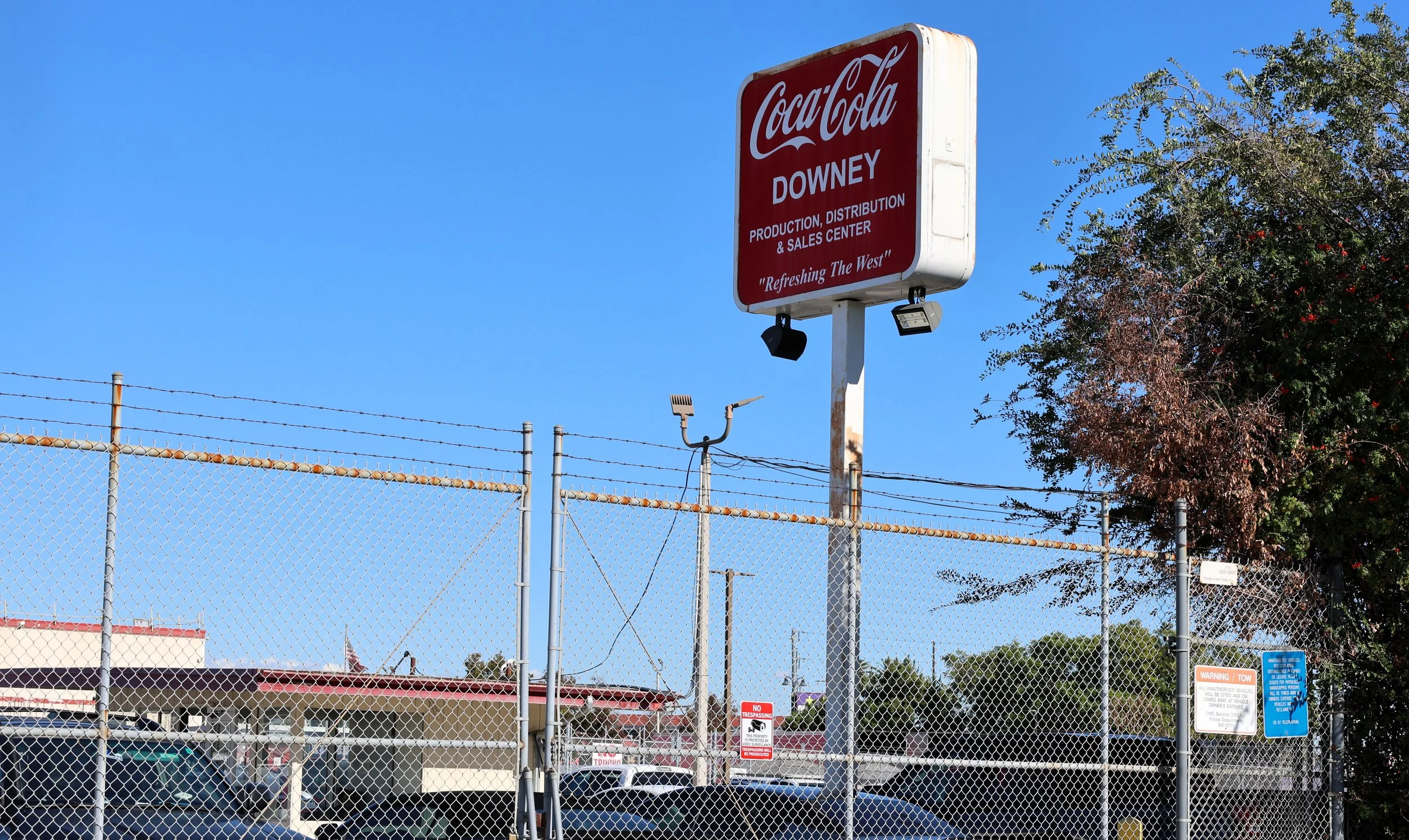
The Coca-Cola bottling plant on Cleta Street in Downey, where Reyes Coca-Cola Bottling is proposing a two-phase expansion. The Planning Commission will consider the proposal Wednesday. (Photo by Eric Pierce)
11/19/2026 Update: The expansion was approved on a 3-0 vote with chair Carrie Uva abstaining and commissioner Mario Guerra absent.
DOWNEY — The Downey Planning Commission on Wednesday will consider a two-phase expansion of the Coca-Cola bottling plant on Cleta Street that would add a nearly 90,000-square-foot building and an on-site power system that captures carbon dioxide from generator exhaust for use in carbonating beverages.
Reyes Coca-Cola Bottling proposes to build both phases within its existing 41-acre campus at 8729 Cleta St., where beverage bottling began in the late 1950s. The plant employs about 730 people on-site across three shifts, with another 170 remote employees associated with the Downey operation, according to a city staff report.
The first phase would add an 89,889-square-foot building with manufacturing, warehouse and office space, rooftop solar panels and six trailer loading docks. The building would house a new line for manufacturing and handling packaging materials, including bottle caps, empty cans, can wraps and cardboard.
A separate 3,275-square-foot ingredient cooler would be built next to the existing truck docks along Patton Road after the new building is completed.
The added space would give the plant more room to store raw materials and handle products shipped in from other facilities. City staff expects the expansion to improve how the plant moves, stores and loads products while maintaining current staffing and annual production capacity of 82 million cases. Loading and refrigeration would continue around the clock.
The second phase calls for natural gas generators capable of producing about 3 megawatts of electricity. The system would recover heat from the generators to chill water for refrigeration and capture and purify carbon dioxide from the exhaust for use in bottling.
Producing beverage-grade carbon dioxide on-site would reduce the need for deliveries of the gas, according to city staff. Three towers would reach about 89 feet, and the system would operate 24 hours a day.
City planners say it would be the first such system in Reyes Coca-Cola Bottling’s West Coast network and the second in Coca-Cola’s U.S. bottling network. A Coca-Cola bottler outside New York City already operates a similar system.
The expansion would shift about 31 daily truck trips from the Patton Road gate near homes and PIH Health Downey Hospital to the plant’s main entrance at Lakewood and Bellflower boulevards. Some ingredient deliveries would continue to use a smaller loading area on Patton Road.
A traffic study projects that the shift would add about two seconds to the average delay per vehicle at Lakewood and Bellflower during the evening rush. Proposed conditions would prohibit trucks serving the plant from lining up, parking or idling off-site. The operator would have to redirect arriving trucks to an approved alternate entrance and staging area if the queue extends into the public right of way or gate processing takes more than 90 seconds.
Reyes is also seeking permission to build 8-foot screening walls and fences along portions of Patton Road and Cleta Street, where city rules generally allow up to 6 feet. The company proposed the taller barriers after residents raised concerns about noise and views of industrial activity during community meetings, according to the staff report.
A proposed parking exception would allow the plant to operate with roughly 455 passenger vehicle spaces once the power system is installed. City code otherwise requires 815 spaces. A parking study found that demand peaked at 425 spaces.
Separately, the staff report says PIH Health Downey Hospital leases 306 spaces on the Coca-Cola property under an agreement that expires in 2029.
Some street resurfacing on Patton Road could take place within about 45 feet of the hospital building. Under proposed safeguards, Reyes would have to work with the hospital to identify areas with vibration-sensitive equipment and monitor ground movement during certain construction work.
Crews would have to use lower-vibration methods within 150 feet of identified sensitive equipment or areas, where vibratory rollers would be prohibited.
The commission will also consider an environmental review that concludes the project’s potentially significant effects can be reduced through safeguards.
An environmental advocacy group, Supporters Alliance for Environmental Responsibility, requested a more extensive environmental impact report. The South Coast Air Quality Management District also raised questions about emissions and potential health risks.
City staff says supplemental analysis shows emissions would remain below the district’s significance thresholds and concludes that a full environmental impact report is unnecessary.
The staff report does not specify a project cost or construction start date.