
Downey’s past: from vacant lots to civic pride
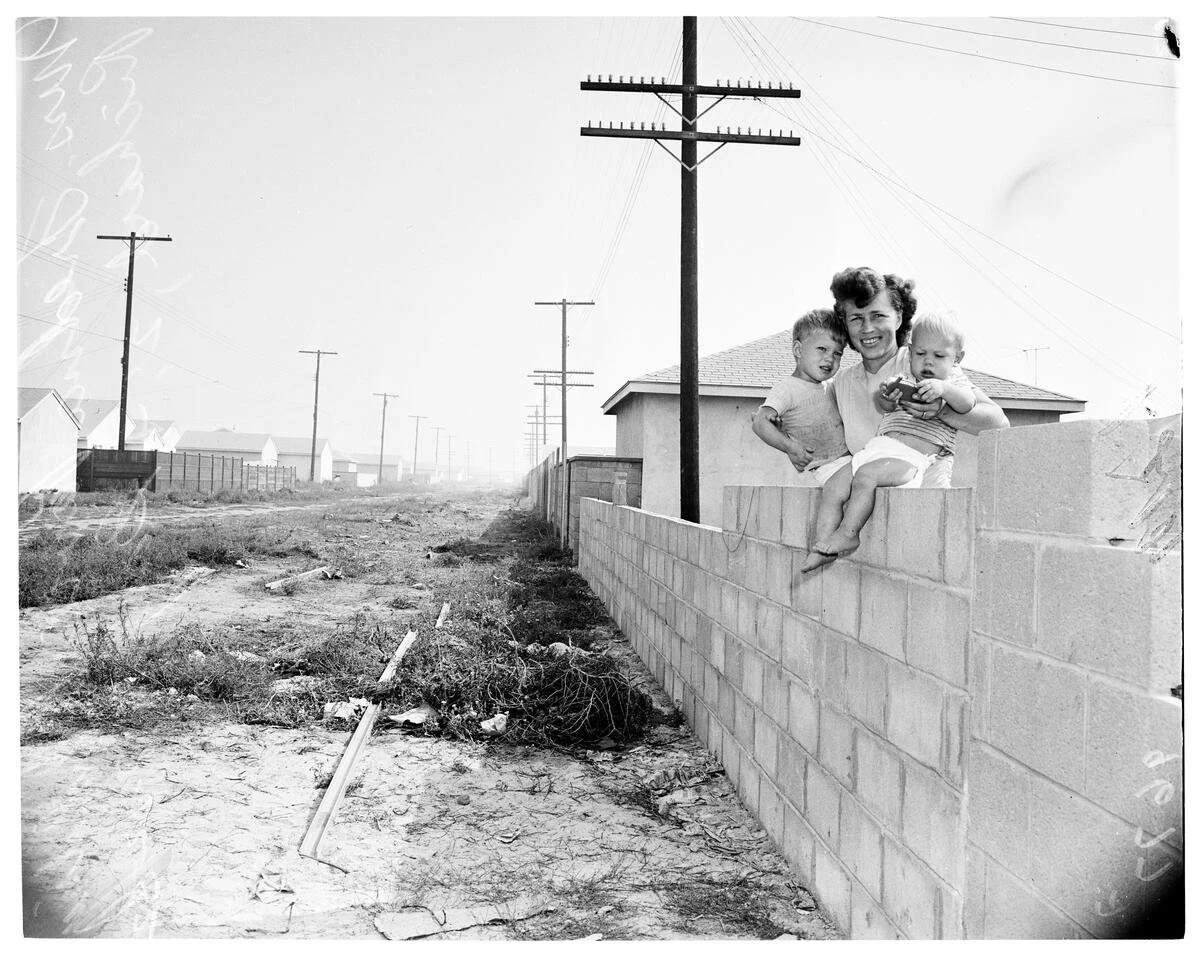
Fredna Pavlich and her children, Richard Pavlich, 2, and Gary Pavlich, 1, at their Downey home along Southern Pacific train tracks on Aug. 22, 1952. (Doheny Memorial Library photo)
Adults often look back with real nostalgia to childhood and the days of the old vacant lot. In today’s modern era, most children live some distance from the nearest school, park, beach or recreation area. They are transported to these places by car, if available, or they play in the backyard, in the street or watch television.
A few vacant lots are still scattered around town, but they are changing. Some parents view them as hazards, places with deep holes, hidden strangers and other perils. Property owners, wanting to keep lots presentable and marketable, post “For Sale” or “Keep Off” signs and maintain them for an eventual sale that always seems just around the corner. Vacant lots today are often seen as a nuisance to the social and economic landscape.
Before World War II, however, many recall the vacant lot as an essential part of growing up. Parents regarded them as safe playgrounds close to home. Realtors paid little attention to how the land was used, since a sale might be years away.
Childhood memories often centered on lots overgrown with eight-foot weeds and grass, filled with paths and hiding places. Children would crawl through them on hands and knees, exploring until it was time to leave. Occasionally, a realtor would have the lot cleared. When that happened, children quickly transformed the open space into a makeshift softball field or football gridiron.
Some lots even featured hand-dug caves, carefully shored up and used as gathering places for neighborhood kids. Though some mothers worried about collapses, none occurred. It was a childhood that could be dangerously exciting, but it also fostered independence, confidence and resilience.
Today, at least 100 homes stand where those vacant lots once were. But the memories created there have not been forgotten. Visitors are encouraged to stop by the Downey History Center and share their own stories of those bygone spaces.
The women who helped shape Downey’s cultural life
As the hardships of pioneering gave way to a more leisurely enjoyment of its rewards, the women of Downey began to devote time and talent to civic and cultural improvement. In 1898, they organized a women’s club known as the Friday Afternoon Club, marking a new stage in the community’s development.
The first stages of a pioneer settlement typically included establishing a church and a school, often sharing a single building. A cultural organization, however, could wait until residents had more time to devote to community enrichment.
In December 1898, seven determined women met at the home of Mrs. J. W. McKellar to found Downey’s first women’s club. Their stated purpose was to promote the social, moral and intellectual interests of the community and to establish a public library. While the language of their bylaws was formal, their approach was practical and action-oriented.
The club initially met on Fridays, but attendance was limited. Recognizing that Friday was a busy day, members changed the meeting day to Saturday in 1901 and renamed the group the Saturday Afternoon Club.
Meetings were held in members’ homes until 1910, when the club acquired its own clubhouse at Firestone Boulevard and New Street. In 1913, meetings moved to Wednesdays, though the name remained unchanged. By 1925, the organization adopted a more fitting name: the Women’s Club of Downey. In September 1950, it moved into its current building at Paramount Boulevard and Lubec Street.
The club’s early leadership included many prominent pioneer families, including DeNure, Golden, Kendrick, Sublins, Bagley, Kinney, McKellar, Darby, Stout, Hatch, Rives, Rinker and Tweedy. The presidents were often the wives of men who carried these names, but their contributions stood firmly on their own.
Through lectures, concerts and civic initiatives, these women brought cultural refinement to the growing community. One of their most lasting achievements was the establishment of a public library in 1901 under the guidance of M. Josie McKellar. A small fee supported the purchase of books until the collection was eventually absorbed into the Los Angeles County Library system as it expanded.
Their work reflects a broader truth about community development: needs are identified, met and then carried forward as a city continues to grow.
Bobbi Bruce is a docent with the Downey Historical Society. This story was adapted from “History of Downey” by Charles Russell Quinn and was published in honor of Women’s History Month.