
Four-city alliance pushes business-friendly vision for region
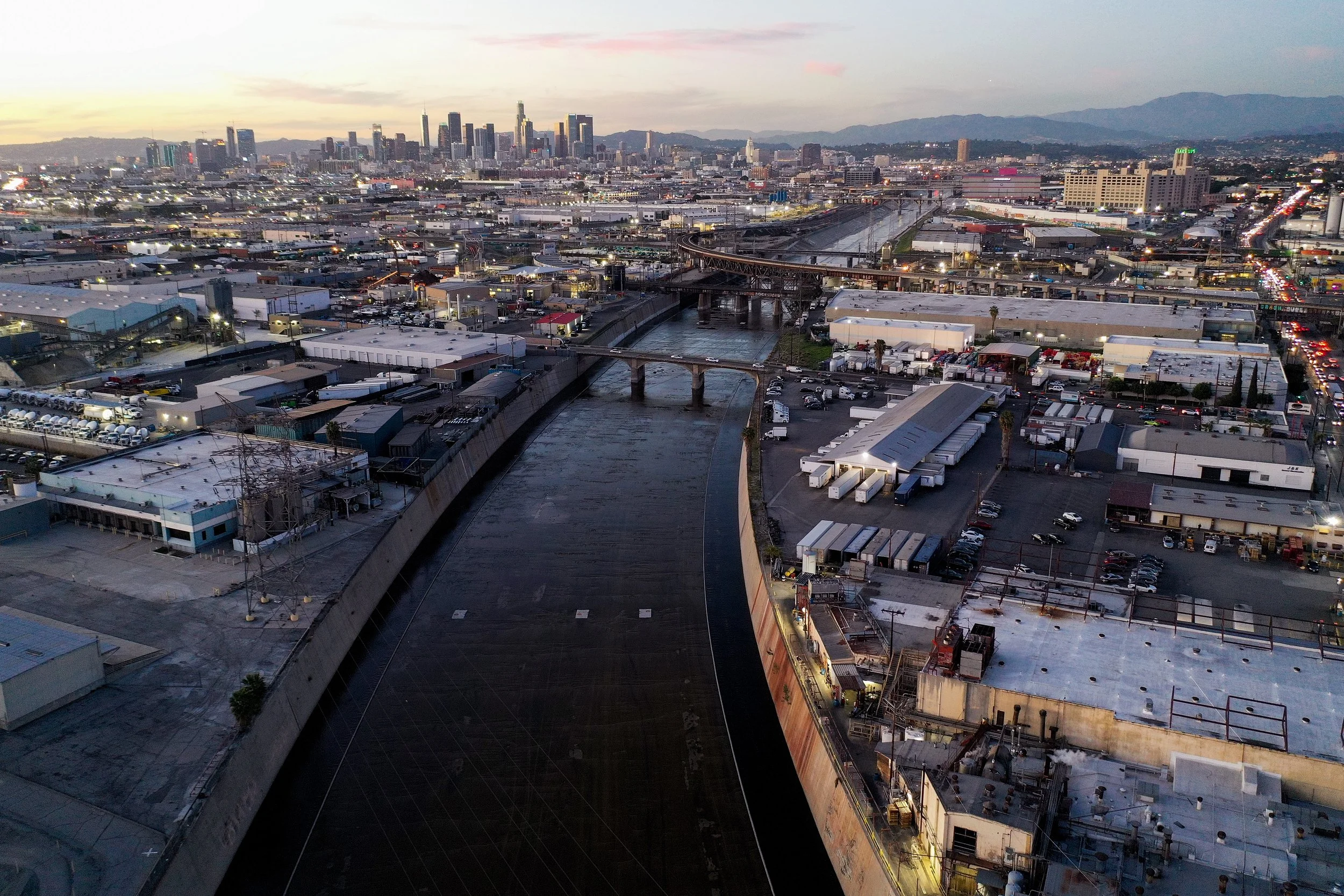
An aerial view of the Los Angeles River running through Vernon. Photo by Mario Tama/Getty Images
Four Southeast Los Angeles County industrial cities launched a new regional alliance this week aimed at strengthening Southern California’s manufacturing and logistics sector amid growing competition from other states and increasing regulatory pressure on the industry.
The cities of Commerce, Industry, Santa Fe Springs and Vernon formally unveiled the “BIG 4” partnership during an inaugural summit that brought together business executives, developers, brokers, manufacturers and public officials to discuss economic development, freight movement and industrial policy.
Organizers described the alliance as an effort to market the four cities collectively as a unified industrial corridor capable of competing with fast-growing Sun Belt states that have aggressively pursued warehouse, logistics and manufacturing investment.
“The BIG 4 Summit was a groundbreaking discussion bringing together elected officials, CEOs, brokers, retailers, logistics leaders, and manufacturers on building a pathway towards a more business-friendly Southern California,” Vernon City Administrator Brian Saeki said in a statement.
According to summit organizers, the four-city corridor represents nearly a quarter-billion square feet of industrial space, roughly 24% of Los Angeles County’s industrial capacity, more than 5,000 businesses and a workforce exceeding 200,000 people.
The cities also emphasized the region’s strategic proximity to the Ports of Los Angeles and Long Beach, Los Angeles International Airport and the county’s freeway freight network. Summit materials stated the corridor processes 31% of all U.S. containerized imports moving through the two ports and handles more than 600 million tons of freight annually.
Stephen Cheung, president and chief executive officer of the Los Angeles County Economic Development Corporation, said the alliance reflects a broader regional strategy focused on economic competitiveness.
“The Big 4 Summit demonstrates the power of regional collaboration in strengthening one of the nation’s most critical industrial and logistics corridors,” Cheung said. “By aligning across cities and sectors, this partnership helps drive business growth, create quality jobs, and sustain long-term economic competitiveness for Los Angeles County.”
Commerce City Manager Ernie Hernandez said the cities are focused on attracting investment while protecting existing employers during a period of rising living costs.
“Our cities are focused on creating good-paying jobs and securing new investment within the BIG 4,” Hernandez said. “With rising costs for gas, groceries, and rent, these efforts are vital to our residents and our region.”
Industry City Manager Joshua Nelson said the summit also served as an opportunity for local governments to hear directly from business leaders about the barriers to expanding operations in California.
One of the summit’s central discussions focused on California’s environmental regulations affecting warehouses and freight operations, particularly the South Coast Air Quality Management District’s Warehouse Indirect Source Rule, also known as the WAIRE Program.
The conference featured a presentation from Supply Chain Federation CEO Tim Jemal and Ramboll Principal Lakshmi Jayaram regarding a newly updated analysis examining the costs and effectiveness of the rule.
The report argues that current warehouse indirect source regulations impose significant financial burdens on warehouse operators while producing limited emissions reductions beyond those already being achieved through existing state and federal clean-truck regulations.
Under the WAIRE Program, warehouses larger than 100,000 square feet must earn compliance points tied to truck activity or pay mitigation fees. The Ramboll analysis concluded that actual compliance costs may be three to nine times higher than originally estimated by regulators.
The report also contends that many emissions reductions credited to the program are instead attributable to broader California regulations governing heavy-duty trucks and cleaner fuels.
Among the report’s findings was an assertion that warehouse operators often lack direct control over the trucking fleets servicing their facilities, making compliance difficult without paying mitigation fees. The study characterized the program as functioning largely as a tax on warehouse operations.
The report further warned that stricter warehouse regulations could encourage businesses to relocate outside regulated regions, potentially increasing freight trip lengths and shifting emissions elsewhere rather than reducing them overall.
Jemal said during the summit that expanding indirect source rules nationwide could increase costs throughout the supply chain without producing the environmental outcomes policymakers intend.
“The updated analysis makes clear that expanding ISR policies would export higher costs and operational disruption nationwide — without delivering the environmental results policymakers are trying to achieve,” Jemal said.
Supporters of warehouse regulations have argued the rules are necessary to address air quality concerns and environmental impacts in communities located near large freight and logistics centers.
The BIG 4 alliance, however, framed the summit as part of a broader effort to demonstrate that industrial growth and economic development can continue in California through regional cooperation and business-friendly policies.
“Change and innovation start in our cities,” Santa Fe Springs City Manager René Bobadilla said. “The BIG 4 is the case study to show the rest of California that investment and jobs will come back and stay in California if cities lead.”