
My hometown Downey
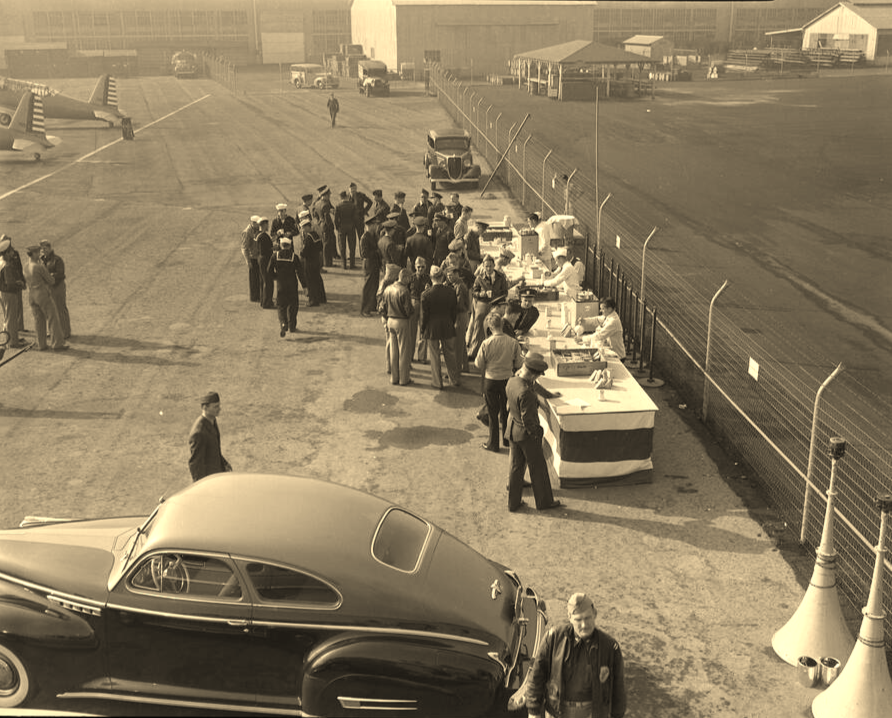
Vultee aircraft workers enjoy catered coffee and sandwiches as 123 trainers are delivered to the Downey facility 1941. (USC collection)
DOWNEY – At the age of 88, my thoughts turn to my hometown of Downey, where I grew up and recall the memories of my youth.
The Downey of my childhood was the 1940s and 1950s, and I remember it well. The fragrance of orange groves, the stench of smudge pots, and the small watercraft gliding along Firestone Boulevard during flooding in downtown Downey.
There were the World War II years, with the production of fighter planes camouflaged at the Vultee Aircraft Factory and the deafening sounds of ack-ack fire from an anti-aircraft battery at the northeast corner of Fifth Street and Paramount Boulevard.
Gone but not forgotten are popular eating and watering holes such as The Pow Wow, Uncle Gabriel’s Log Cabin, Memory House, Timpones, Chris & Pitts BBQ, The Hearth and the Silver Saddle. For us kids there was Ritchie’s Drive-In and, later, Harvey’s Broiler. Fine dining could be found at Welch’s in Bixby Knolls or Don the Beachcomber in Hollywood. Prom night might find us kids at the Palladium in Hollywood.
Downey Avenue, between Fifth Street and Firestone Boulevard, was our “Main Street,” lined with small mom-and-pop stores, including Zella Brumley’s women’s clothing store and the drugstore run by the cantankerous Mr. Pulley. For the boys, there was no greater thrill than gunning your twin 18-inch glass packs between Second Street and Third Street, creating a deafening noise that reverberated between the buildings on the east and west sides of Downey Avenue — all while trying to avoid the Sheriff.
The main attraction on Downey Avenue was the Meralta Theater, which clearly upstaged its poor country cousin, the L-shaped Avenue Theater, where I saw the 1950s version of pornography, “The Outlaw,” starring Jane Russell — probably the worst movie ever made. The Meralta, however, was a first-class venue with a single screen, general admission and deluxe loge seats, a smoking room and usherettes with flashlights who escorted you to your chosen seat. Major movie premieres were highlighted by giant searchlights parked in front of the theater.
Kids’ Saturday matinees included two feature films, a cartoon, coming attractions, newsreels and a serial such as “Secret Agent X-9.” Of course, for the more romantically inclined, there was the Rosecrans Drive-In in Paramount, sometimes referred to as “the Passion Pit.”
In the 1940s and mid-1950s, Downey High School was the only high school. There was a grammar school located on the current library and City Hall site, and the junior and senior high schools were located east of Brookshire on the existing high school campus. The south end of the football field, along with the administration and auditorium buildings, faced Firestone Boulevard.
The girl students were terrific. Most, but not all, wanted to be wives, mothers and homemakers. They dressed modestly and had no life-scarring tattoos. The boys generally wore Levi’s and white T-shirts and had no earrings, body piercings or tattoos. Drugs were not available and were not an issue. We didn’t have sex education classes, but we all ultimately figured it out.
Trying to make everyone feel good wasn’t an issue. Song and cheerleading groups were small squads, usually five or six at most. If you didn’t make the team or were cut, you were disappointed, but you learned to handle it. Ribbons were for first, second and third place. There were no participation ribbons to make you feel good.
In retrospect, we grew up in one of the finest communities imaginable — Downey. We survived with no seat belts, no cell phones and no computers. We played outside and invented our own games. We shot BB guns and played marbles and hopscotch. We ate real butter and drank whole milk.
For the most part, we had a mom at home, with the mom being the homemaker and dad the breadwinner. We respected our parents, who always sided with the police, the teacher, the principal and the judge. There was no “why are you picking on my kid?” These lessons taught us to be accountable and to think for ourselves. Spankings were the norm, and “time out” was not an option.
I loved my hometown of Downey. It engendered in me a love of country, respect for educators and law enforcement, and a sense of accountability.
But most of all, my hometown Downey gave me something I cherish above all else. It gave me a 16-year-old Downey High School song leader, my high school sweetheart, Mary Wright ’56. After five years of dating, 68 years of marriage, five children and 13 grandchildren, she remains the greatest treasure I found in my hometown Downey.