
'Ma Rainey’s Black Bottom' a masterclass in American theatre
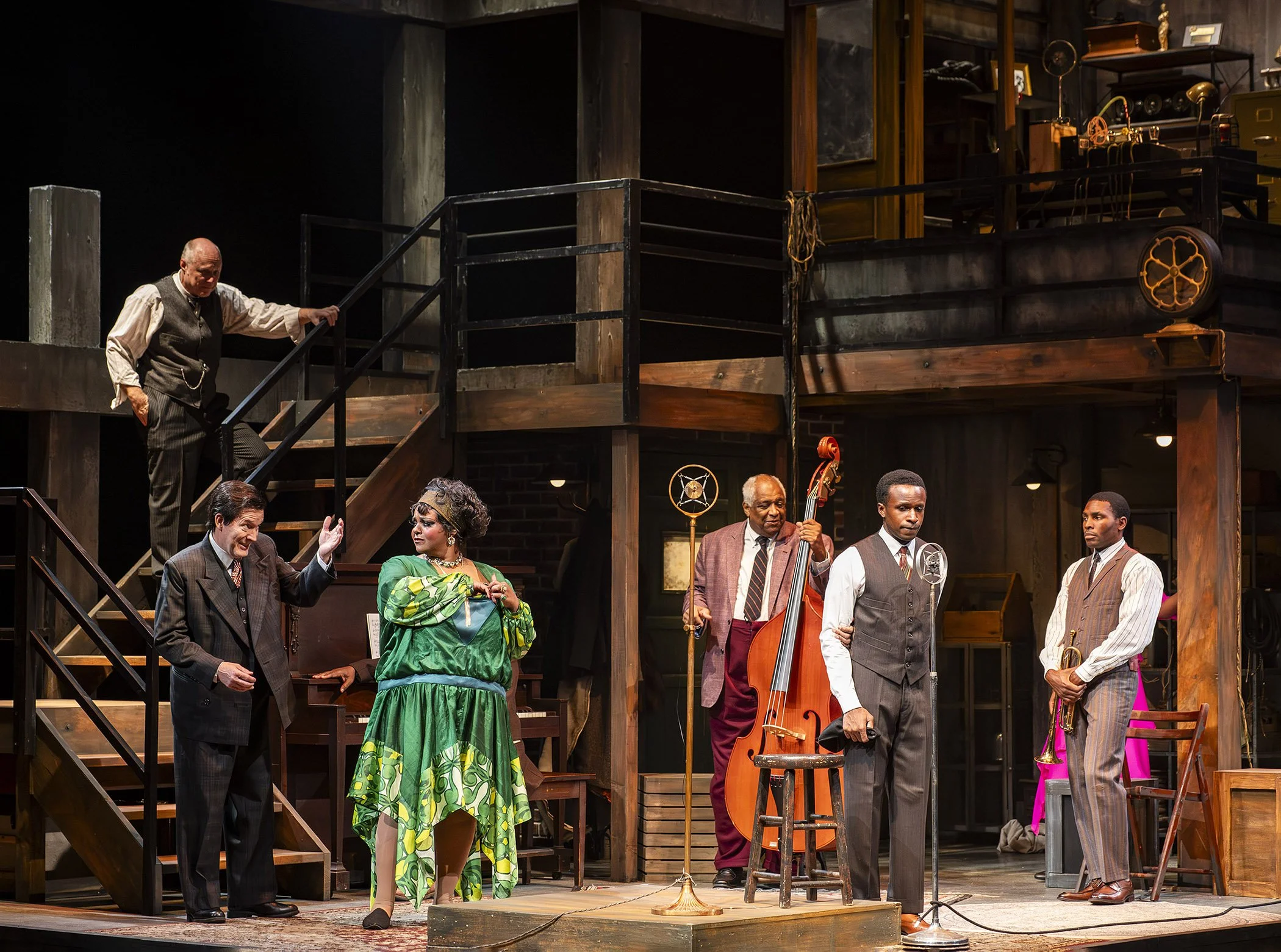
Matt Foyer, Bert Emmett, Amber Liekhus, Alex Morris, Francis C. Edemobi, and Jamar Gilbert. (Photo by Craig Schwartz)
As I was approaching A Noise Within Theatre in Pasadena, I noticed their motto on the outside of the building: “Classic Theatre, Modern Magic.” That’s a perfect description of what’s happening on stage in their current production of August Wilson’s “Ma Rainey’s Black Bottom,” seamlessly directed by Gregg T. Daniel. Wilson couldn’t be in better hands.
I asked numerous patrons what had brought them to this play. Their unanimous answer was “August Wilson.”
Two-time Pulitzer Prize and Tony Award winner August Wilson is one of America’s great playwrights, best known for his American Century Cycle, a collection of 10 plays, each set in a different decade of the 20th century. The plays focus on an artistic, emotional and social history rather than a textbook record. All are set in Pittsburgh’s Hill District except for “Ma Rainey.” Together, they chronicle the Black experience in 20th-century America and form, in the words of drama critic John Lahr, “a kind of fever chart of the unmooring trauma of slavery.”
A Noise Within has committed to producing all 10 plays, with only three to go. Daniel has directed all seven.
Our first glimpse of this magic is scenic designer Tesshi Nakagawa’s realistic, rundown 1927 Chicago recording studio. The three-tiered layout visually traps the characters on the main floor of the recording studio and the musicians, who are relegated to the band room on the lower level. The white owner looks down from the recording booth upstairs. All is complemented by Ken Booth’s lighting design. Standing witness are two vintage microphones on stands.
Over the years, I have tried to learn a little musicology and accumulated an outrageous number of CDs. Among them is a five-CD series on the UK Document label that includes Ma Rainey’s original 1927 remastered 78 rpm recording of “Ma Rainey’s Black Bottom,” recorded in Chicago for Paramount with her Georgia Jazz Band, including Thomas A. Dorsey on piano and Louis Armstrong on trumpet.
While touring in the South, she picked up the blues, and after writing her own blues songs, she introduced them to a wider audience. Mamie Smith may have recorded the first blues song with her 1920 “Crazy Blues” on Okeh Records, but it was Ma Rainey who first bridged the gap between the raw rural folk sounds of the Deep South and the theatrical polish of vaudeville.
Paramount marketed her as the “Mother of the Blues” and was the predominant label releasing race records targeting Black audiences. Paramount rented studios in Chicago to record blues artists and kept its production costs as low as possible. They pressed her tracks on cheap, low-grade shellac, often resulting in a scratchy sound. She recorded more than 100 records, mentoring Bessie Smith along the way.
Director Daniel has added a dramatic, surrealistic prologue in which two of the musicians accompany Ma’s younger girlfriend, Dussie May (CJ Obilom), through the audience to the microphone downstage. There, it appears that Dussie May, standing in front of the microphone, is possessed by a demonic presence as she attempts in vain to open her mouth and sing.
In this very brief moment, sound designer extraordinaire Jeff Gardner works the first of his magic, giving us a snippet of Big Mama Thornton’s 1953 blues recording of “Hound Dog.” Hound dog was common Black slang for a cheap gigolo. Songwriters Leiber & Stoller were drawn to Black music, blues, jazz and R&B. They wrote it for Thornton, who injected it with rage and anger. It was a massive R&B hit. Thornton was paid a flat $500 fee with no rights to the 1953 recording.
In the next moment, the song morphs into Elvis Presley’s popular 1956 “Hound Dog,” which contributed to his financial success and international fame. Although he had heard Thornton’s version, Presley didn’t use it directly. Instead, he used a version by Freddie Bell and the Bellboys, with altered lyrics and an upbeat tempo that made the song about a dog that couldn’t catch a rabbit. Presley paid royalties to the publisher. Thornton received very little money or credit for the original trailblazing version.
Is it a chilling metaphor for the silencing and historical theft of Black artistic voices?
Does this foreshadow a central conflict in the play … having your voice controlled by outside forces?
Is it an image of the 1920s predatory white managers and studio owners who exploited the talents of Black artists?
The play divides our attention between Ma Rainey’s struggle with the white owner of the recording studio, Sturdyvant (Matt Foyer), and her white manager (Bert Emmett), and the interaction of the four musicians in her band.
From the beginning, the performances and action are so real and believable it is as if we were in the same room.
As they prepare for Ma’s arrival, Sturdyvant is demanding that Irwin control Ma this time. In turn, Irwin is calming Sturdyvant down because Ma is late. It would be so much easier to capture Ma’s voice without Ma.
Three members of the band arrive and hang out in the band room, where they engage in banter, storytelling, smoking reefer and making digs at each other.
We’re in August Wilson territory, with the actors giving us vivid characters, each with an undiluted voice of their own. There’s a lot of humor here.
Christine Cover Ferro’s costumes and Shiela Dorn’s wigs and makeup define these colorful characters and complement the production’s earthy palette.
Slow Drag (Alex Morris), the bass player, is eager to get this session over so he can indulge in earthly pleasures. He has a talent for storytelling and humor.
Cutler (Kaiser A. Ealy) is the bandleader and trombone player who knows it’s best to play by the rules. He is quietly rolling a reefer. We learn he is a religious man. This is a seasoned group of musicians. Cutler and Slow Drag have spent 22 years in the band.
Toledo (Gerald C. Rivers), the piano player, is the only one who can read. If he doesn’t have his nose in a book, he’s quick to share his wisdom, often philosophizing on history and the bigger picture of the plight of the Black man.
Enter Levee (Jamar Gilbert), the trumpet player who’s spent his week’s wages on a pair of Florsheim shoes fresh out of the box. They sure do shine. He’s excited. He has plans.
He may not be able to read, but he can write music, and he’s written his own jazzed-up version of “Black Bottom.” Mr. Sturdyvant said he would look at it and his other songs. He’s young and he’s got a future. Enough with these other sad-sack musicians and their jug band music. Ma’s going to record his new version of her song. He’s going to have his own band.
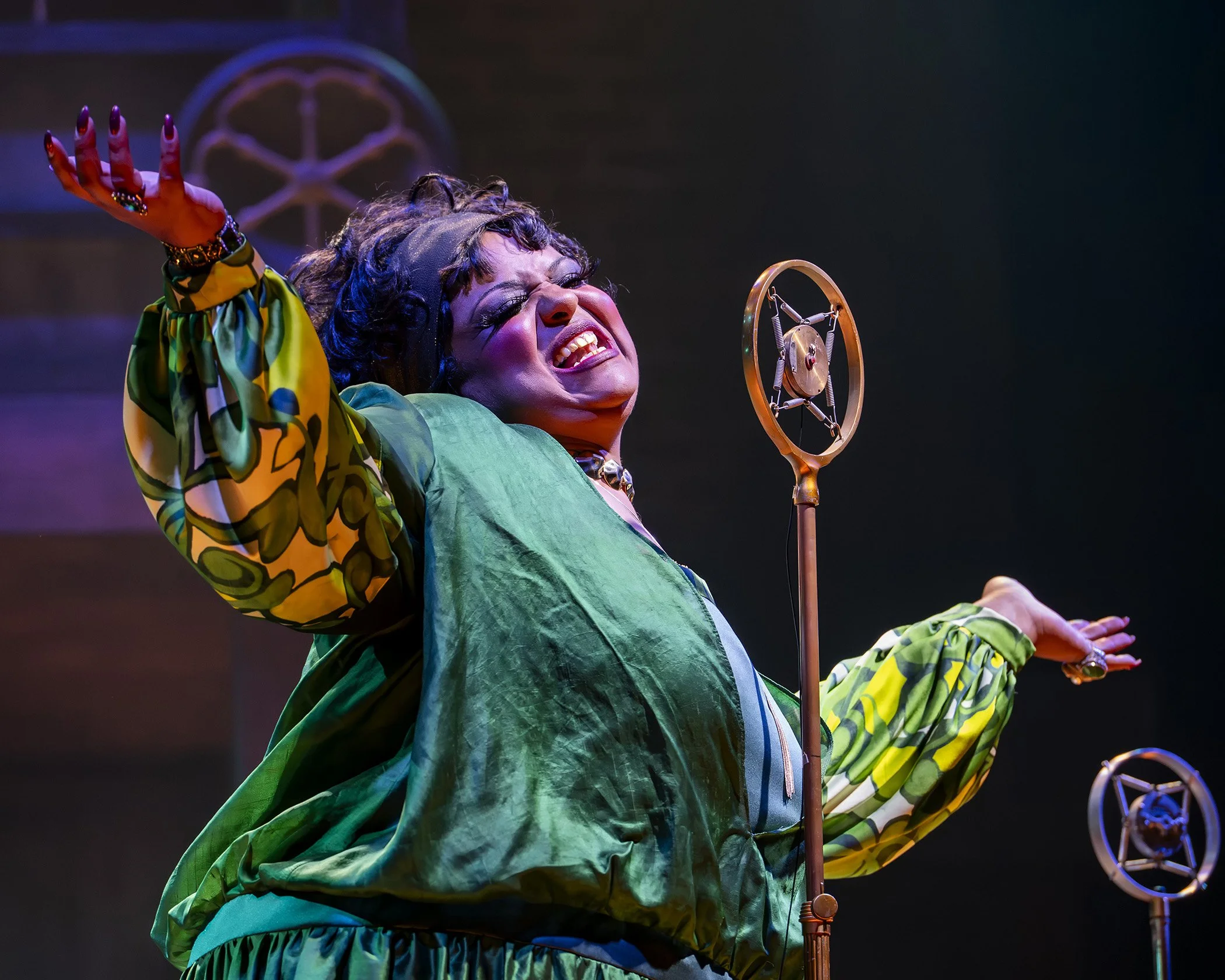
Amber Liekhus (Photo by Craig Schwartz)
As much as the other three musicians make digs at one another, it’s Levee who is difficult for them to put up with. His boasting. His cockiness. His arrogance. He puts them all down, especially Toledo. And Toledo responds. They know how to get at each other.
As we learn his backstory, Gilbert makes it clear that underneath, he’s a living, breathing time bomb.
The humor changes. The digs are deeper. The stories darker. Bubbling underneath are years of suffering, racism, resentment, anger, ambition … and questioning, as Levee yells, “Where was your God when I needed him!”
When Ma (Amber Liekhus) arrives with her nephew Sylvester (Francis C. Ememobi) and her girlfriend Dussie May (CJ Obilom), she holds court.
Ma knows exactly what she is doing. She says it out loud. Walking on the street in Chicago, she’s just a dog to them. But here in the recording studio, she’s the Queen and they need her. And she leverages every bit of power she can.
By her side, Obilom’s Dussie May exudes a sharp magnetism. If Ma wants her manager to pay off a Chicago cop (James Nardini), she’s going to get it. If she wants a Coke and the deli is closed, she’s going to get it. If she wants her nephew Sylvester to introduce the song on the recording, she’s going to get it.
We discover Sylvester stutters. Ememobi injects a tender humor here. It’s tense. But Ma’s going to get her way.
Blues music has its roots in hard times, heartbreak and resilience. Amber Liekhus’ live performance of “Ma Rainey’s Black Bottom” is bluesy, infectiously passionate and full of emotion. Liekhus is a genuine talent.
Ealy, Gilbert, Morris and Rivers are exceptional actors. Not only are we hanging on to each of their characters, but we’re digging them playing the music. Cutler counts off with, “One, Two, You Know What To Do,” and they’re off.
They are getting the most out of their instruments, hitting those notes, swaying and moving with the music.
Except they aren’t playing the music.
These actors absolutely convince you they are. It’s a little more magic from sound designer Jeff Gardner. Perhaps the most astonishing sound design I have seen and heard. It is prerecorded by musicians Vikram Devesthali, Matt Rubin and Michael Saucier and music director Byron Smith. Gardner has isolated the notes and the instruments. We are hearing them from strategically placed speakers.
The emotional weight of the play hangs on the electrifying friction between the two leads. Liekhus commands the stage as Ma Rainey with full authority. Her immovable force meets its match in Gilbert’s Levee, who is masking his deep-seated trauma with an arrogant swagger. The tension between Liekhus and Gilbert anchors the play, driving the narrative toward its devastating climax.
A Noise Within’s “Ma Rainey’s Black Bottom” is a masterclass in American theatre. Daniel navigates the text’s slow burn, building a high-pitched tension with an extraordinary cast. With Liekhus’ soulful performance as Ma and Gilbert’s portrayal of Levee’s rising anguish, we experience a deeply human, electrifying exploration of artistry and identity.
A hauntingly unmissable theatrical experience that lingers in the heart long after the final devastating blackout.
A Noise Within, 3352 East Foothill Blvd., Pasadena. Through Sept. 20. Thursdays and Fridays at 7:30 p.m.; Saturdays at 2 and 7:30 p.m.; Sundays at 2 p.m. (626) 356-3100.