
“St. Megan” explores faith, family and the cost of leaving
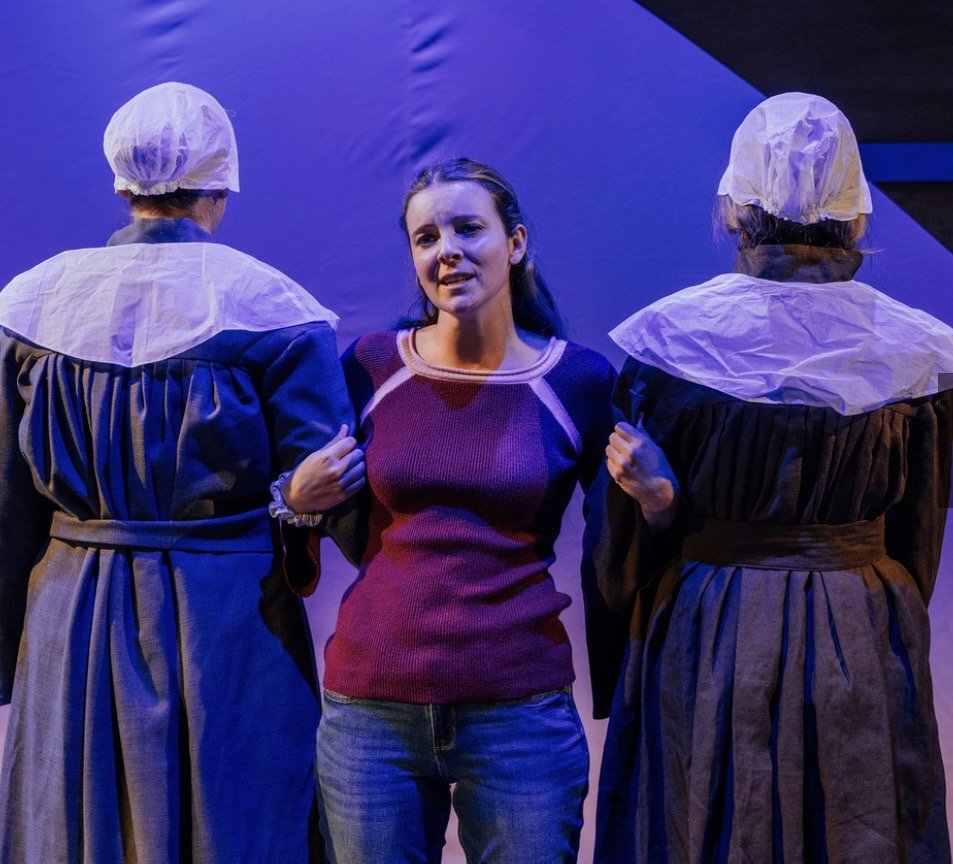
Meg Cain, Caitlin Zambito and Shannon Lee Clair appear in “St. Megan.” Cain plays Grace, Zambito portrays Megan Phelps-Roper, and Clair plays an academic who challenges Shirley Phelps. Photo by Jeff Lorch.
Four Shaker women in traditional religious dress and bonnets take their time setting the stage, moving precisely to simple but beautiful guitar and violin music.
Amanda Knehan’s scenic design is inspired by a Shaker meetinghouse, with minimal details and clean lines. The split backdrop divides the characters’ realities: stage right is Megan’s family; stage left transforms into Chad’s secular world. The final action is a Shaker woman hanging a Shaker chair, as is traditionally done, on one of the pegs that run across the background between the two areas. The audience seems to settle under their spell.
That meditative moment is shattered by the immediate transformation to the shrill sounds of Westboro Baptist Church members in Topeka, Kansas, protesting at a freeway off-ramp across from a military funeral. They believe the deaths of U.S. soldiers are God’s divine retribution for a sinful, doomed nation that tolerates homosexuality and LGBTQ rights.
Westboro Baptist Church has no connection or affiliation with the Baptist Church.
Clad in T-shirts and carrying signs that are exact replicas of the organization’s highly recognizable protest gear, the characters shout slogans such as “God Hates Fags,” “Thank God for Dead Soldiers,” “Thank God for IEDs,” “Fags Go to Hell” and “Pray for More Dead.”
The characters visually pop out at us as an aggressive, unified wall of text against the spare, Shaker-inspired meetinghouse set. Throughout the play, a Shaker woman observes from the sidelines.
This is our introduction to the world premiere of Joy Gregory’s highly impressive “St. Megan,” skillfully directed by Lina Patel in her directorial debut and presented by the legendary Rogue Machine Theatre, known for bringing us adventurous theater in an intimate setting. The play won the 2026 Los Angeles New Play Project Award and was the first developed through Rogue Machine’s Playwrights’ Roundtable.
It is a fictional drama inspired by the true story of Megan Phelps-Roper, granddaughter of Fred Phelps, founder of the Westboro Baptist Church, notorious for its extreme ideologies and aggressive protests.
The group weaponizes public outrage, believing heavy media coverage is the most effective tool. Its slogans include “God’s hatred is one of His holy attributes.” Its picketing is a form of preaching to a “doomed country” that, the group believes, cannot hear its message in any other way.
The Southern Poverty Law Center designates WBC as a tight-knit cult and anti-LGBTQ hate group. The Anti-Defamation League designates WBC as a homophobic, antisemitic and publicity-hungry extremist hate group.
We are introduced to teenage Megan Phelps (Caitlin Zambito) and her sisters Bekah (Cordelia Leigh) and Grace (Meg Cain). The trio of young actors captures the enthusiasm of youth.
Their mother, Shirley (Rachel Sorsa), serves as WBC’s chief spokeswoman, organizer and leader.
Sorsa recently gave us the solo performance of the year in Ian McRae’s “Painted Ponies” at the Ruskin Theatre. Here, Sorsa gives us yet another powerful performance. She portrays a multifaceted woman: a religious fanatic who is strict with her children, an attorney who fights all the way to the Supreme Court for WBC’s First Amendment rights to free speech, and yet a tender, loving mother with deep affection for her children. Sorsa’s portrayal of the unrelenting Shirley is especially stirring in the emotional moments as the play reaches its pivotal ending.
Megan is in charge of the group’s Twitter account. It is there that she and Chad (Zack Rocklin-Waltch) stumble upon each other.
When I first heard there was some kind of Twitter action in the play, I was dreading it. But it is staged and performed so creatively that I was impressed.
Rocklin-Waltch creates a memorable and likable character in Chad. As the play progresses, the talented Zambito becomes thoroughly convincing as Megan as she journeys through her dilemma. In all the madness, humor manages to find its way into the play.
Meg Cain is a striking figure, bringing life and sensitivity to her portrayal of Grace, who joins Megan when they choose to leave. They are not only leaving the church but also their family. And they are shunned.
Cordelia Leigh is a fresh face who shows tremendous potential as Bekah.
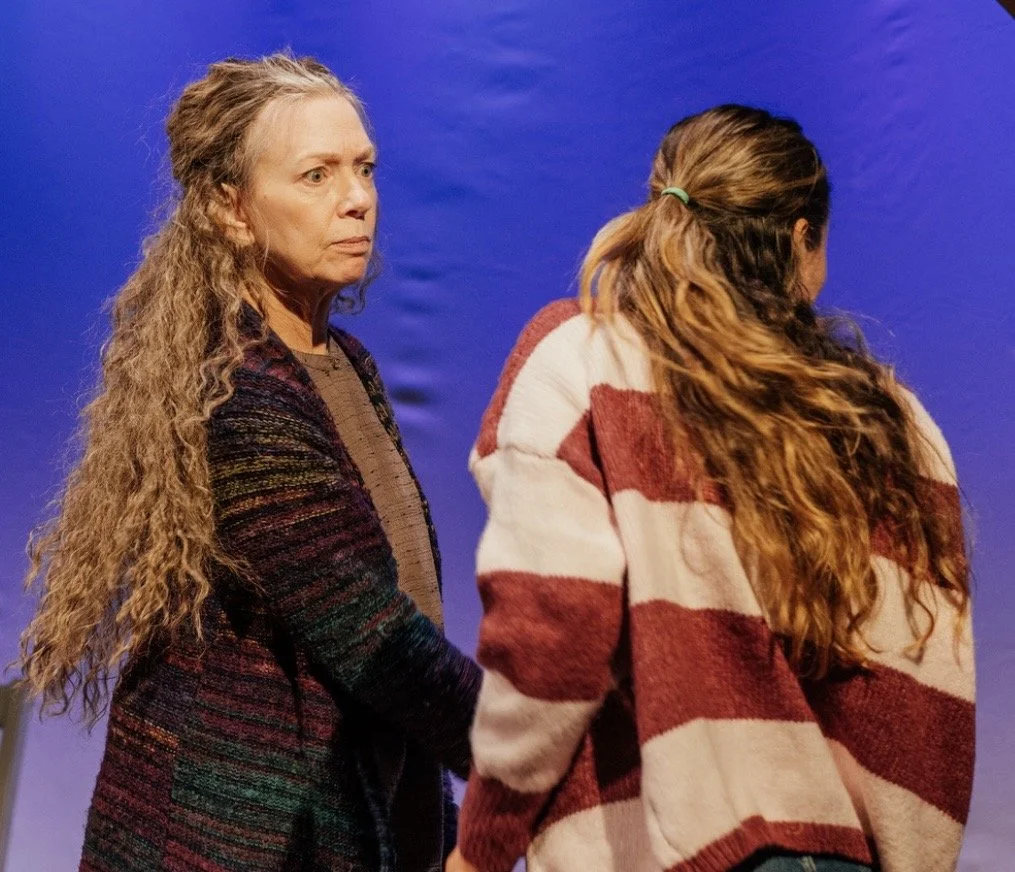
Rachel Sorsa, who plays Shirley Phelps, and Caitlin Zambito, who portrays Megan Phelps-Roper, appear in Rogue Machine Theatre’s “St. Megan.” Photo by Jeff Lorch.
The seasoned actress Shannon Lee Clair is particularly outstanding as the academic who poses difficult questions for Shirley, including, “What is a cult?” In doing so, she tells the history of the Shakers, who began in England in the 18th century and were led by the charismatic Ann Lee, who brought them to the United States, claiming she was the second coming of Christ. Although these religious groups are radically different, they are examples of American religious zealotry.
As difficult as the story of “St. Megan” may be, we are somehow touched by the humanity of the characters.
John Perrin Flynn founded Rogue Machine in 2008 and served as its artistic director. He led the company in its critically acclaimed, brave presentation of new works. Juggling artistic direction while managing the theater is daunting work. I know this from experience as founding artistic and administrative director of Scorpio Rising Theatre (1969-89) and The Other Theatre (2012-13). Flynn stepped down as artistic director last year.
Flynn directed “Grangeville” by Samuel D. Hunter at the Ruskin Theatre earlier this year. A master class in acting and directing, it is my favorite production so far this year. He is also directing the critically acclaimed production of Samuel D. Hunter’s “A Case for the Existence of God,” which is currently running in repertory at Rogue.
The talented Guillermo Cienfuegos is Rogue’s new artistic director. I have been following his work for some time. When I look back over all the theater I have seen over the decades, Cienfuegos’ direction of “Henry V,” for which he won a LADCC directing award at Pacific Resident Theatre, stands out. It was Cienfuegos who invited Joy Gregory into Rogue’s Playwright’s Roundtable. Rogue Machine Theatre is in good hands.
Megan Phelps-Roper’s acclaimed memoir is titled Unfollow: A Memoir of Loving and Leaving the Westboro Baptist Church.
Rogue Machine at the Matrix Theatre, 7657 Melrose Ave., West Hollywood. Fridays and Saturdays at 8 p.m., Sundays at 2 p.m. and Mondays at 8 p.m. Through Nov. 15. www.roguemachinetheatre.org.