
A memory and tribute: Alan Mandell our great man of the theatre
The remarkable theater actor, director, administrator and arts advocate Alan Mandell died Tuesday, Oct. 13, at age 98. He was a definitive interpreter of Samuel Beckett’s plays.
A highlight in theater history was the 2012 Mark Taper Forum production of Samuel Beckett’s “Waiting for Godot,” featuring Alan Mandell and Barry McGovern and directed by Michael Arabian.
I was reading about Mandell when I stumbled upon a memory and a connection I hadn’t realized.
In 1970, I saw a riveting performance of “The Cage” by the Barbwire Theatre. It featured an actor named Rick Cluchey and three other actors. It was a raw, in-your-face performance. They transformed an empty space into a theater, and I liked it. The performance was in the student union at CSULA, and I had seen a tiny announcement in the student newspaper. There weren’t any theater students there. No professors had mentioned it. I doubt any students had actually come to see it. Mostly, students just happened to be in the student union, and it just happened.
Set inside a symbolic prison cell, the play follows three seasoned inmates who continuously manipulate and torment one another, playing mind games to maintain a sliver of ego and sanity in their degrading confinement. Their fragile dynamic is shattered when a fourth cellmate, a young, innocent man who suffers from epilepsy, is introduced. The older inmates ultimately subject the newcomer to a harrowing mock trial. Cluchey explicitly wrote “The Cage” to shock audiences into advocating for prison reform by exposing the dehumanizing, survival-of-the-fittest reality of life behind bars.
Today, I made a connection I hadn’t realized at the time. Cluchey was an inmate at San Quentin when the San Francisco Actor’s Workshop staged its historic and legendary performance of “Waiting for Godot.” Cluchey was confined to his cell and didn’t see the performance. He heard it over the prison loudspeaker, and that night his cellmate told him all about it.
They stayed up all night talking about it. His cellmate described a specific, powerful scene: “Everyone was puzzled until one guy came in with a rope around his neck and another guy whipping him and guess what his name was? Lucky!”
I knew about the San Francisco Actor’s Workshop. I knew Alan Mandell had performed the role of the slave Lucky in that legendary performance of “Waiting for Godot” at San Quentin. I knew about the San Quentin Drama Workshop. I knew Samuel Beckett became involved.
What I didn’t know was that the artistic collaboration between actor Alan Mandell and inmate-turned-playwright Rick Cluchey created one of the most legendary chapters in American theater history. It directly sparked the creation of the San Quentin Drama Workshop and forged a lifelong connection to the renowned Irish playwright Samuel Beckett. Intensely moved by how prisoners responded to his work, Beckett took Cluchey under his wing, becoming a close mentor and lifelong friend.
On Nov. 19, 1957, the San Francisco Actor’s Workshop traveled to San Quentin State Prison to perform Samuel Beckett’s absurdist masterpiece, “Waiting for Godot.” Alan Mandell performed the pivotal role of Lucky, a submissive character led around by a rope wrapped around his neck.
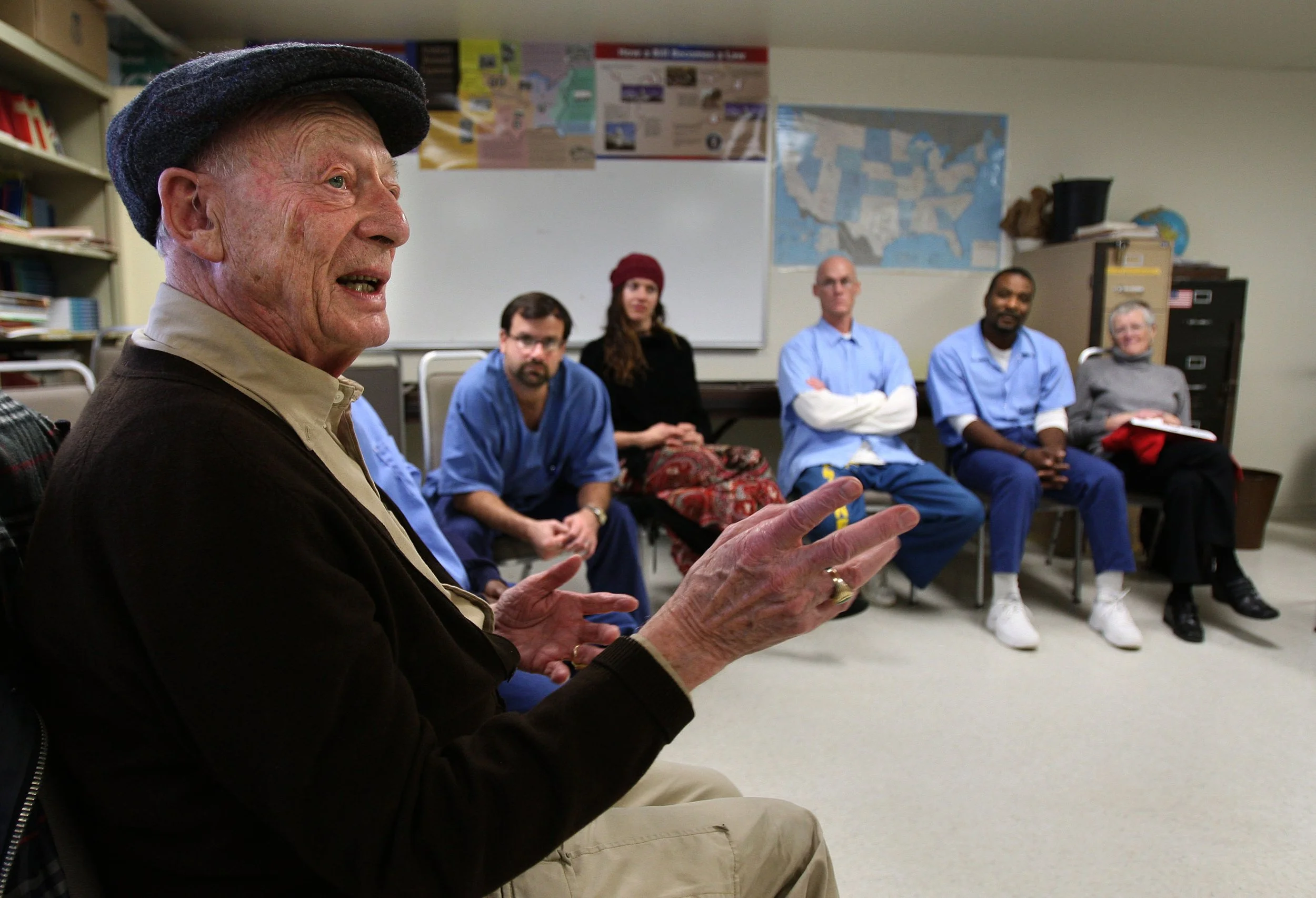
Alan Mandell is an original cast member of the play, "Looking for Godot" which was performed in 1957 at San Quentin State Prison in San Rafael, Calif., Mandell visits the San Quentin Drama Workshop on Friday Dec. 19, 2008, to talk tot he inmates about his experience performing the play 51 years ago. (Photo By Michael Macor/The San Francisco Chronicle via Getty Images)
Rick Cluchey was a 24-year-old inmate serving a life sentence without the possibility of parole for armed robbery and kidnapping. Because authorities deemed him a high security risk, Cluchey wasn’t permitted to sit in the live audience. Instead, he listened to Mandell’s performance broadcast into his cell over the prison’s audio loudspeaker system.
The play’s existential themes of confinement and endless waiting resonated profoundly with Cluchey and his fellow inmates. Recognizing that Beckett had perfectly captured the psychological essence of imprisonment, Cluchey resolved to dedicate his mind to theater.
Inspired by the production, Cluchey and a group of prisoners successfully petitioned the prison warden to establish their own acting troupe. In 1958, Cluchey co-founded the San Quentin Drama Workshop alongside Alan Mandell, who served as its outside artistic adviser and mentor.
Operating inside the prison until 1965, the workshop became the first extended prison theater program in the United States initiated and run entirely by prisoners. The inmates mounted dozens of productions, including several of Beckett’s works. Theater became Cluchey’s path to redemption. He even began writing his own plays, including “The Cage,” his gripping drama about life behind bars.
Mandell and the theater community actively advocated for Cluchey, ultimately helping him secure parole and release in late 1966.
After his release, Cluchey kept the San Quentin Drama Workshop alive outside the prison. As other members of the prison troupe were paroled, Cluchey would meet them at the prison gates and recruit them back into the theater company. Their Barbwire Theatre toured hundreds of U.S. college campuses, performing “The Cage” and Beckett’s works.
Remarkably, their work caught the attention of Samuel Beckett himself. Cluchey and Mandell formed a profound, decades-long working relationship with the legendary writer. Beckett personally directed both Cluchey and Mandell in European and American productions of “Waiting for Godot,” “Endgame” and “Krapp’s Last Tape.”
Cluchey went on to become one of the premier global interpreters of Beckett’s works. In the acclaimed 1987 TV film “Beckett Directs Beckett,” Cluchey starred as Pozzo, sharing the stage with Alan Mandell, who played Lucky — the very character whose description had ignited Cluchey’s imagination through a prison cell door 30 years earlier.
Their extraordinary story of prison redemption later served as the core creative inspiration for the 1987 feature film “Weeds,” starring Nick Nolte. Cluchey simply dismissed the film and its celebrity and continued doing theater.