
Housing, parking and Trader Joe’s: A conversation with Hector Sosa
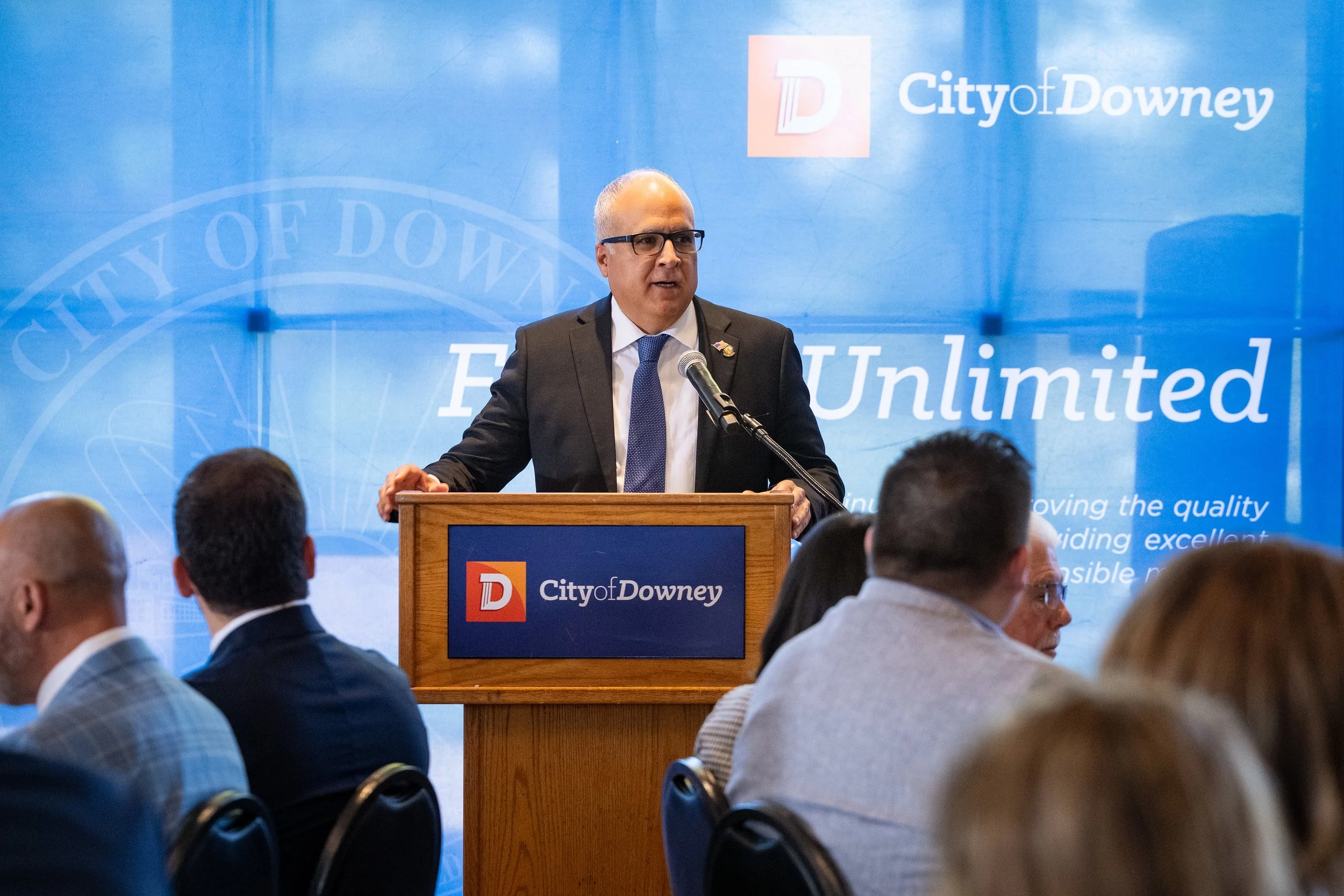
City of Downey photo
DOWNEY — How does Downey accommodate more housing without overburdening city services? What should determine the price of a parking ticket? And what, exactly, is keeping Trader Joe’s from opening here?
Those were among the questions Jorge Somoano and Greg Page brought to a recent conversation with Councilman Hector Sosa as part of their “Editor for a Day” experience with the Downey Patriot.
The two won the opportunity at the newspaper’s gala last month. Their discussion with Sosa moved from the responsibilities of elected office to development, city finances and the challenges of getting things done at City Hall.
Sosa said one of his earliest discoveries after joining the council was how much work the position involved, along with the number of procedures and details behind seemingly straightforward decisions.
“There’s a lot of little details, a lot of moving pieces behind the scenes in local government,” he said.
The experience has taught him patience. Regulations and public processes take time, he said, even when officials agree on the desired outcome.
Somoano, whose career in municipal utilities included serving as Burbank’s Water and Power director, brought that experience to the discussion, asking how council priorities become policies and how staff carries them out.
Sosa said he believes elected officials should set direction while allowing department leaders to do the jobs they were hired to perform.
“I’m not going to try to come in and act like I know more police work than the chief or more public works than our public works director,” he said.
He also said disagreement among council members can be valuable, giving decisions the benefit of different perspectives.
Housing and the services that come with it
Asked about Downey’s most pressing issues, Sosa pointed to accommodating additional housing while maintaining the services residents expect.
In dealing with Sacramento housing mandates, he acknowledged the need for more homes, citing the expense of both renting and buying. But additional residents also mean greater demands on public safety, public works and other departments, he said.
For Sosa, the question extends beyond approving construction to ensuring the city has the staffing, resources and revenue to support a larger population.
His personal preference would be single-family homes, he said, but Downey’s limited available land makes that difficult. Taller townhome developments offer another path to homeownership, although he acknowledged they do not always match the character of surrounding neighborhoods.
“My preference all day would be single-family homes,” he said. “We just don’t have the space for it.”
Sosa also discussed the county-owned Rancho Los Amigos South Campus, saying conversations with Los Angeles County have included housing, some retail and an emphasis on open green space.
He said discussions with Supervisor Janice Hahn’s office had made progress, while emphasizing the importance of preserving opportunities for outdoor space as development moves forward.
Small businesses and city finances
Asked what he was proudest of during his council service, Sosa cited a lower permit fee structure for small businesses and bringing a men’s mental health awareness fair to Downey, both with council support.
As a small-business owner, he said, he understands how startup expenses and permitting costs can discourage someone from opening a business.
“We want people to come to Downey and start a business,” he said.
Sosa also pointed to what he described as the city’s 14th consecutive balanced budget, saying maintaining reserves and scrutinizing spending remain priorities as operating costs increase.
Public safety comes first, he said, but other departments must receive adequate support. He singled out public works employees as the “unsung heroes” who keep the city running.
Looking ahead, Sosa said he wants Downey to attract more high-paying professional jobs, building on its medical institutions and history in aerospace. He sees opportunities for those workers to support local businesses and for downtown to offer more shopping and greater walkability.
Somoano pressed him on whether attracting those jobs was an adopted council policy or an individual goal.
Sosa clarified that the council had not adopted a specific policy on that objective, although he said it had been discussed during annual planning and budgeting conversations.
More trees, with a plan
Sosa said he has requested a review of Downey’s tree canopy and management practices, including opportunities to plant additional trees in areas with inadequate shade.
He described expanding the canopy as a long-term investment, while acknowledging that some residents have concerns about maintenance or do not want a tree in front of their homes.
Those concerns, he said, are part of the reason for seeking a fuller report on planting and maintenance.
“You’re not going to make everybody happy,” Sosa said. “This is the wrong business to be in if you’re worried about making everybody happy.”
What should a parking ticket cost?
A discussion of parking fines became a broader conversation about the purpose of city charges.
Sosa questioned whether higher fines would improve compliance, saying an approximately $38 ticket can already be an unwelcome expense for an avoidable violation.
Somoano asked whether the city should examine the cost of enforcement when considering fine amounts, including staff time and other expenses.
Sosa agreed that costs should inform the discussion rather than selecting an increase arbitrarily. He also said additional revenue supporting more enforcement could be a reason to consider an adjustment.
The conversation returned repeatedly to a practical point: A higher fine has limited effect if violations go unenforced.
Sosa acknowledged the frustration of drivers occupying short-term spaces beyond the posted limit, while noting that enforcement employees cannot be everywhere at once.
The inevitable Trader Joe’s question
Eventually, the conversation reached a familiar Downey topic: Trader Joe’s.
Sosa said he and his wife shop at the Cerritos location, where they regularly encounter other Downey residents.
He said potential locations in Downey have been considered, including the Rite Aid property at Firestone Boulevard and Rives Avenue and a site near Diosa. Parking requirements have been an obstacle, he said.
“Trader Joe’s knows very well that the city of Downey wants them here,” Sosa said. “The residents of Downey want them here.”
He left open the possibility of a future store, but said the decision rests with the company.
And if it happens, he suggested, residents will eventually find another business to put on their wish list.
“We’ll move on to something else that we really want here,” he said. “It just never stops.”