
‘Speaking in Tongues’ finds faith in a changing world
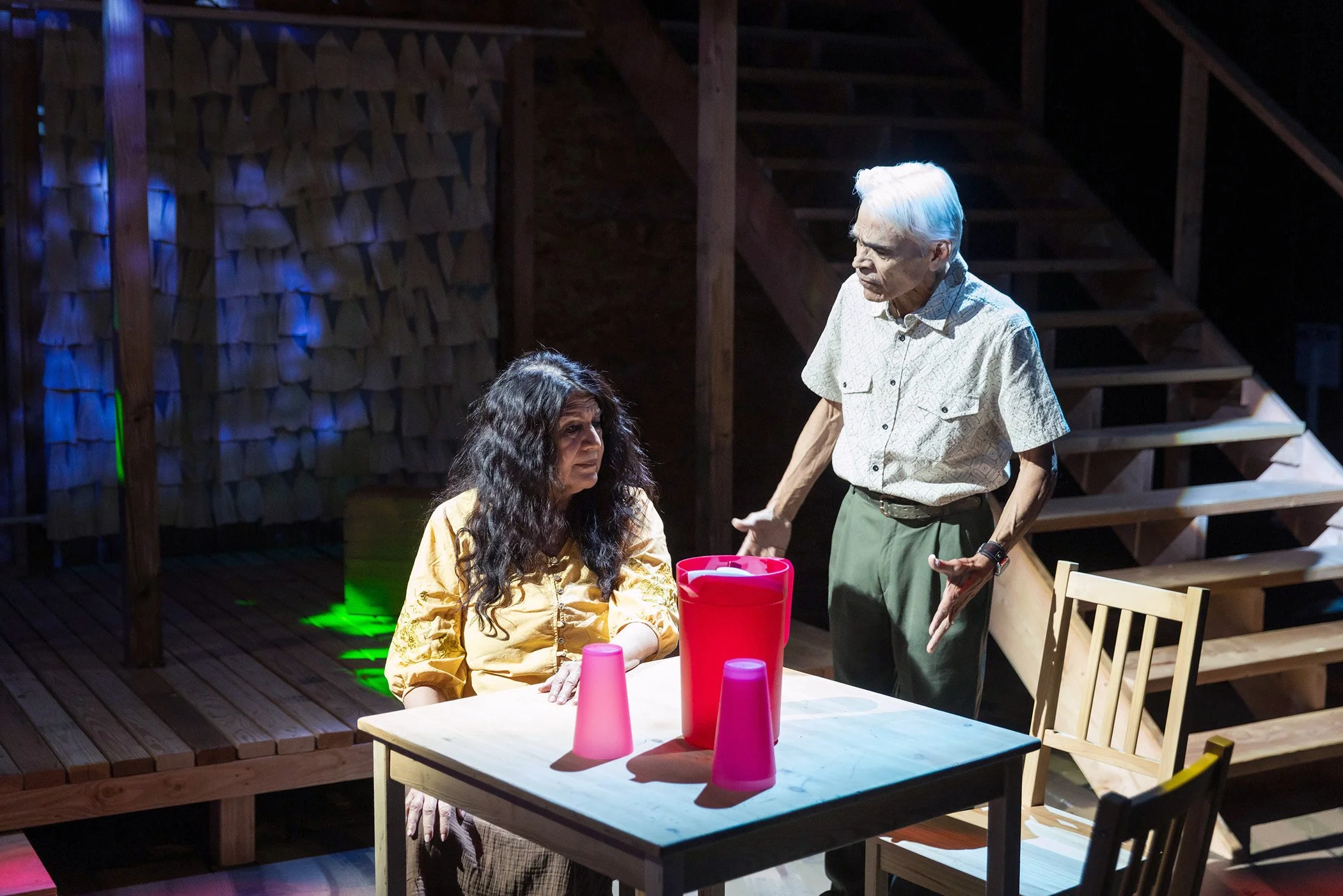
Evelina Fernández and Sal López in ‘Speaking Tongues.’ (Photo by Grettel Cortes Photography)
Theatre is collaboration. The highly acclaimed Luis Alfaro is one of our very finest contemporary playwrights. Alfaro continues to collaborate with others and explore the language and magic of what can only happen in the live theatrical experience.
There’s more to theatre than just the spoken words. There is the space between, the inner lives, the sound, movement and images. He has been leaning into a more experimental style inspired by his mentor, Maria Irene Fornes, the “Mother of Latinx Theatre,” along with the gentleness and landscape in the writing of playwright Horton Foote and inspiration from Samuel Beckett.
Interestingly, he doesn’t write the final scene until the production is deep into its final rehearsals.
His latest play draws on his family’s roots in Delano, his Pentecostal background, and the Chicano identity and journey. It was developed in the Latino Theatre Company’s Circle of Imaginistas playwrights’ group. The company’s ensemble has been working together for 41 years. Alfaro, acclaimed director José Luis Valenzuela and the ensemble have bonded through this work, and Alfaro has been able to craft his characters with the actors. The creation of a new play is a journey of discovery.
The world premiere of Alfaro’s “Speaking in Tongues” transports us to a small Chicano Pentecostal community navigating faith and isolation in the impoverished Central Valley town of Earlimart. This deeply evocative production explores what happens when the community’s core traditions begin to splinter and its congregation dwindles to four remaining members.
Oh, and the pastor disappeared eight weeks ago.
In the early 20th century, Pentecostal churches spread throughout Central California, often gathering with farmworkers in fields or beneath a tree. Centered on the omnipresence of the Holy Spirit, salvation through faith, speaking in tongues and divine healing, the faith offered a vital escape from the harsh, grueling reality of long, unrewarding days in the fields.
The tension between the earthly and the cosmic is physically presented in Prairie T. Trivuth’s striking, multitiered set design. A humble, abandoned, pine-framed church is covered with faded, wilted corn leaves. Xinyuan Li (Lee)’s lighting complements it, as do the sounds of insect and animal life designed by Robert J. Revell.
Extending from the roof and directly overhead is a towering, wilting cornfield. Stairs at stage left force the actors to climb between everyday survival and spiritual wandering.
Corn, or maíz, is foundational to Chicano culture. In the 1960s and ’70s, the Chicano movement looked to its ancestral roots. Corn is central to the Mayan creation myth and to the Aztecs and the legendary homeland of Aztlán. To Chicanos, corn is a powerful reminder of who they are and where they come from.
The production, direction and entire ensemble are exceptional: Evelina Fernández, Lucy Rodríguez, Sal López, Geoffrey Rivas and Esperanza America.
The gospel song “Oh Happy Day” is beautifully performed by Esperanza America.
In the cornfield, Hermana Romie (Fernández), the seemingly unhinged wife of the pastor, prays hard to her Lord and Savior. Throughout the play, she spends a vast amount of time wandering and sweeping the adjacent cornfields. Is she preparing for something?
There’s lots of humor here, and these actors pull it off.
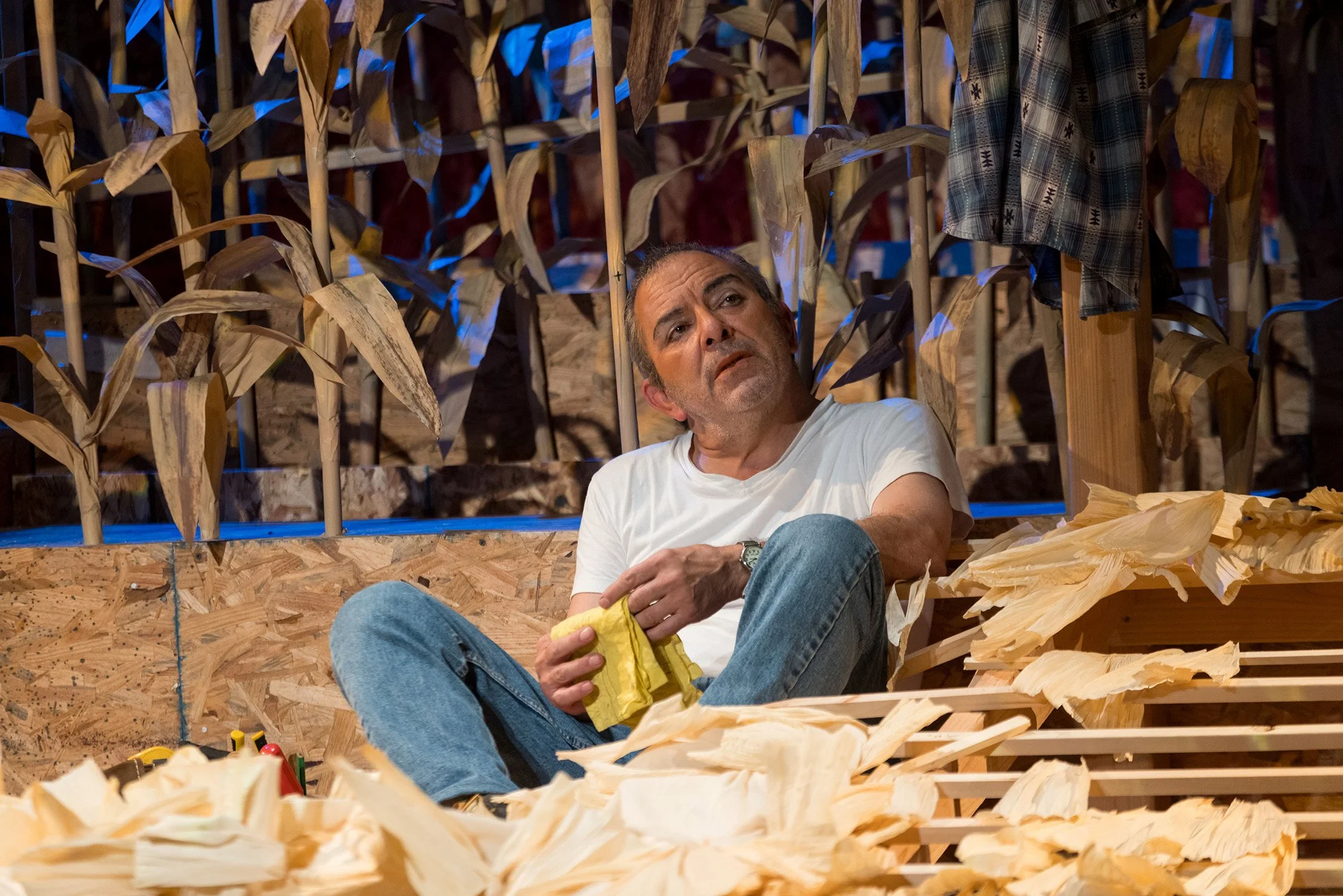
Geoffrey Rivas in ‘Speaking in Tongues.’ (Photo by Grettel Cortes Photography)
Hermano Mando (López) finds his lifelong friend and fellow congregant Hermano Tico (Rivas) asleep on the roof. Tico has spent the night up there in the heat of the valley because he was too tired to come down. A scriptural quote quickly follows everything he says. Mando follows along.
Mando confesses his sin of buying a new Ford Mustang with the savings he shared with his wife, who has now decided to divorce him. Tico confesses his sin of watching TikTok and getting so angry he wants to punch everyone.
Mando is concerned about the missing church pastor. He thinks the pastor’s wife may have murdered him.
Mando and Tico treat the disappearance in their slow-moving community like a high-stakes murder investigation, using language they have picked up from binge-watching A&E’s true-crime series “The First 48.”
It’s a running gag.
The TV series emphasizes that the first 48 hours are critical to solving a homicide. But the men return to casually bickering and gossiping about a church sister in a cornfield, and wondering who is going to bring the protein to their next church potluck while their pastor is missing.
Forget the first 48 hours. He’s been gone eight weeks.
Wait. Everyone made potato salad? Oh no! There’s too much potato salad and no chicken wings!
Enter Hermana Cubby (Rodríguez). Her specialty is her award-winning potato salad, and she is outraged.
She’s a riot as she fires off a list of everyone else’s sins in her sanctimonious tone. Along with a bit of scripture. And a request for forgiveness. She’s the ultimate unyielding church lady archetype.
She tells the story of the women who joined together to make and sell tamales, keeping the church going. The men did nothing. Keep your eye on the corn.
Enter Sister Tiri (America), the daughter of the pastor and Hermana Romie, who brings chicken wings. Protein! Another woman saves the day.
Tiri has moved to Porterville. Someone asks if that means she is now a Mexican American and no longer a Chicano. Part of a younger generation no longer connected with the church, Tiri intends to abandon the Pentecostal church for a life in Los Angeles. Romie doesn’t try to force Tiri back to the church.
Throughout the play, when Hermana Romie enters, she is captured frozen, bathed in red light, as if caught in a scream. It serves as a powerful theatrical device representing the overwhelming weight of a suppressed spiritual gift, frozen trauma and her ultimate breaking away from patriarchal church constraints.
Romie finally reveals that she was the author of her husband’s powerful spiritual sermons. She was forced to suppress her own gifts due to the church’s strict gender policies, continuing the illusion that the men run the church while the women regularly attend, raise money and keep the traditions alive. She reveals the mystery of the missing pastor, her broken marriage and the patriarchal structure she upheld.
Hermana Romie wants to leave the church building and move her ministry and revival back to the sacred land. To “the origin of the big tree,” which represents a collective historical reality and a profound spiritual symbol. A place where earlier farmworkers gathered for open-air worship, tent revivals and intense prayer meetings under the shade of massive trees to escape the valley heat.
Romie’s return to the land puts her at odds with Hermana Cubby, who speaks of their struggle and long, hard work to build this church. Keep it as it is. But who will keep it going?
Mando and Cubby have their own struggle to keep the spirit alive in a world they see being destroyed by climate change, ICE raids and the loss of a way of life.
Any new work by Luis Alfaro is a cause for celebration. “Speaking in Tongues” is a theatrical journey and experience you don’t want to miss.
The Latino Theater Company at LATC, 514 S. Spring St., Los Angeles. Performances Thursday through Saturday at 8 p.m. and Sunday at 2 p.m., through Nov. 15. For information, visit [latinotheaterco.org](https://www.latinotheaterco.org/).